In a previous post,we discovered how the National Police Agency in Japan keeps a detailed account of how many motorcycle gang members there are around the nation. It's important to keep an accurate score in Japan, so I was not so surprised to read that according to a recent article related to homeless people, the Japanese government's Ministry of Health, Labour and Welfare was quoted as saying that there are 8,265 homeless people in Japan. Not wanting to take this report from the Times of India at face value, I checked on the Ministry's website and found that in 2009 they calculated that there were 15,759 homeless people in the nation, down from 25,296 in 2003.
As with the motorcycle gang members, the data seems incredibly precise, so – as a hard-hitting news hound – I thought it would be important to find out how they were able to get such accurate data.
I called in and made an appointment at the Ministry of Health, Labour and Welfare to talk to someone about this question. They set me up with a Mr. Chosa, Sub-Assistant Databank Controller.
His secretary escorted me to his office and introduced me.
Mr. Chosa: Oh! They didn't say anything about a foreigner.
Me: Uh... should I come back as someone else later?
Mr. Chosa Ha ha! No, please sit down (points to a large, overstuffed chair in front of his desk). What can I do for you?
Me: I have a question about the number of homeless in Japan.
Mr. Chosa: Sure, sure... go ahead!
Me: A recent article stated that there are 8,265 homeless people in the whole country – this in comparison to more than 600,000 in the US which only has about 3 times the population of Japan.
Mr. Chosa: Yes, it is a serious problem in the United States.
Me: But what I was wondering is how you can come up with such a precise figure. I mean, why is it 8,265 homeless people and not 8,264 or 8,266 people?
Mr. Chosa: (looking at me like I have a learning disability) We know how to count here in Japan. Our students regularly score at the top of the ratings in international comparative math examinations. (He looks at me as if that answers the question.)
Me: I see... so how DO you actually count them to get such a precise figure?
Mr. Chosa: With counters. Maybe you have seen people using these at sports events and so on? They stand outside the entrances and click the counters for each person who enters? It's not a high-tech thing (he raises his eyebrows as if I might think they were).
Me: So you send people out to count them?
Mr. Chosa: Sure. It's a very demanding job, and we have to hire a lot of people to do the work.
Me: But there are homeless people everywhere. I have seen them, living along the river in my rural community. How can you possibly count them all?
Mr. Chosa: Like I said, it's very demanding. We need to canvas all of the likely places and cross-check and so on... it's not easy (he bowed his head as if he – personally – had suffered from the difficulty of it).
Me: Cross-checking! I was going to ask about that. How could you be sure you weren't counting people more than one time.
Mr. Chosa: Yes, that is a very important part of our work.
Me: So who do you hire to do this work of counting all the homeless.
Mr. Chosa: (looking at me like I was deprived of oxygen as a fetus) The homeless, of course.
Me: You hire homeless people to count homeless people?
Mr. Chosa: Who better?
Me: So how do you cross-check their results to make sure they are not counting people several times.
Mr. Chosa: It's easy. We have them all come into one of our public facilities and compare notes. It takes days.
Me: Do they count themselves then too?
Mr. Chosa: Of course not. While they are in the public facilities they are not homeless, so they do not count themselves. That's part of the deal.
Me: Ah... so Japan's homeless rate is so low despite a struggling economy.....
Mr. Chosa: What are you implying?
Me: Nothing... nothing.... thank you very much for your time.
Mr. Chosa: We here at the Welfare Ministry are always happy to help.
Showing posts with label Japanese politics. Show all posts
Showing posts with label Japanese politics. Show all posts
Monday, November 11, 2013


Monday, June 3, 2013
The Pandas Against the World
The Chinese mean business now. No more Mr. Nice Guy.
A Chinese military official has laid it all out. America is no longer the Paper Tiger of the Mao era; oh no! It is a real Global Tiger and Japan is its Running Dog.... oops... dated expression... um... Wolf. Australia, a kind-hearted Lamb (take THAT you macho Aussies!), is warned not to side with the Tiger and the Wolf against China (a Panda?) in the struggle to identify who actually owns the Senkaku Islands (the Pandas call them the Diaoyu Islands).
The Global Tiger and the Wolf are "madly biting China", according to the Colonel in the Chinese army. Poor China. One hopes they don't catch something from all that biting.
What if the Kind-Hearted Lambs should side with the Wolf and the Tiger? The Panda will assert its claim to parts of Australia no doubt, based on some historical claim of having sent ships there before anyone arrived from Europe.
They will issue another statement, "The Panda claim to the southern continents is proven in history. There is nothing to discuss. The southern continent is an irrevocable part of Pandaland. We claim them along with all of the seas between our mainland and our southern territories of what is called Australia today."
The Global Tiger, on the other hand, might say, "We support the Kind-Hearted Lambs in their desire to remain free and independent of Panda domination, but we also wish they would be less lamby and more tigery about this.... just saying."
The Wolf (Japan, in case you have not been paying attention) would say, "While recognizing the rights of Pandas and Lambs to live in harmony around the world, we Wolves insist on the right of most animals to live in peace whenever possible and if not, to try to work it out among themselves and bring new awakenings that might turn to our general advantage in our common will and striving for world acceptance."
The Global Tiger would respond to this new initiative by the Wolves by saying, "Huh?"
And – naturally – the Pandas would throw a hissy-fit claiming, "Wolf attempts at regional hegemony will be met by the strong and inviolable determination of all Pandas everywhere to prevent a repeat of historical mistakes!" They would encourage Panda riots in the streets in Pandaland and the unavoidable trashing and closure of Wolf stores and embassies.
The Wolves would respond with uncommon sternness, "Events in Pandaland have taken on a character of their own and established a momentum that can only lead to a fundamental revocation and arrangement from the world of nations, fostering a general disadvantage in the climate among these nations and a decrease in the positive atmosphere of general development.... among nations... or between them.... and retroactively."
This would clearly be a provocation to the Pandas who would send "research" vessels into Wolf waters to prove that not only the little islands but also the big islands of Okinawa Prefecture are an inviolable part of Panda territory.
The Wolves would respond by sternly announcing in their Parliament that "vessels from other countries, entering Wolf waters should be aware that we are prepared to take strong measures against them; such as taking video of them for the evening news, exposing their perfidy to the world."
Escalating the tensions, the Pandas would send fishing boats to expose the imperialist and adventurist ambitions of the Wolves who are running dogs of the capitalist Global Tigers, and the Wolves would respond gravely by complaining, "Intrusion by alien vessels into our waters will not be tolerated unless we can determine where they are from and ascertain that they might be on course for other places and unless they have radar that might be locked onto our vessels or weapons systems that look scary."
The Pandas for their part have clearly been feeling local pressures – they ARE an endangered species after all – and what could be better to alleviate their domestic pressures than to lay claim to major chunks of the rest of the world? Lebensraum for Pandas!
Those Pandas, so cute when they get riled up!
A Chinese military official has laid it all out. America is no longer the Paper Tiger of the Mao era; oh no! It is a real Global Tiger and Japan is its Running Dog.... oops... dated expression... um... Wolf. Australia, a kind-hearted Lamb (take THAT you macho Aussies!), is warned not to side with the Tiger and the Wolf against China (a Panda?) in the struggle to identify who actually owns the Senkaku Islands (the Pandas call them the Diaoyu Islands).
The Global Tiger and the Wolf are "madly biting China", according to the Colonel in the Chinese army. Poor China. One hopes they don't catch something from all that biting.
What if the Kind-Hearted Lambs should side with the Wolf and the Tiger? The Panda will assert its claim to parts of Australia no doubt, based on some historical claim of having sent ships there before anyone arrived from Europe.
They will issue another statement, "The Panda claim to the southern continents is proven in history. There is nothing to discuss. The southern continent is an irrevocable part of Pandaland. We claim them along with all of the seas between our mainland and our southern territories of what is called Australia today."
The Global Tiger, on the other hand, might say, "We support the Kind-Hearted Lambs in their desire to remain free and independent of Panda domination, but we also wish they would be less lamby and more tigery about this.... just saying."
The Wolf (Japan, in case you have not been paying attention) would say, "While recognizing the rights of Pandas and Lambs to live in harmony around the world, we Wolves insist on the right of most animals to live in peace whenever possible and if not, to try to work it out among themselves and bring new awakenings that might turn to our general advantage in our common will and striving for world acceptance."
The Global Tiger would respond to this new initiative by the Wolves by saying, "Huh?"
And – naturally – the Pandas would throw a hissy-fit claiming, "Wolf attempts at regional hegemony will be met by the strong and inviolable determination of all Pandas everywhere to prevent a repeat of historical mistakes!" They would encourage Panda riots in the streets in Pandaland and the unavoidable trashing and closure of Wolf stores and embassies.
The Wolves would respond with uncommon sternness, "Events in Pandaland have taken on a character of their own and established a momentum that can only lead to a fundamental revocation and arrangement from the world of nations, fostering a general disadvantage in the climate among these nations and a decrease in the positive atmosphere of general development.... among nations... or between them.... and retroactively."
This would clearly be a provocation to the Pandas who would send "research" vessels into Wolf waters to prove that not only the little islands but also the big islands of Okinawa Prefecture are an inviolable part of Panda territory.
The Wolves would respond by sternly announcing in their Parliament that "vessels from other countries, entering Wolf waters should be aware that we are prepared to take strong measures against them; such as taking video of them for the evening news, exposing their perfidy to the world."
Escalating the tensions, the Pandas would send fishing boats to expose the imperialist and adventurist ambitions of the Wolves who are running dogs of the capitalist Global Tigers, and the Wolves would respond gravely by complaining, "Intrusion by alien vessels into our waters will not be tolerated unless we can determine where they are from and ascertain that they might be on course for other places and unless they have radar that might be locked onto our vessels or weapons systems that look scary."
The Pandas for their part have clearly been feeling local pressures – they ARE an endangered species after all – and what could be better to alleviate their domestic pressures than to lay claim to major chunks of the rest of the world? Lebensraum for Pandas!
Those Pandas, so cute when they get riled up!
Saturday, November 5, 2011
For a Few Dollars More
Once again it is time to stop sitting on the sidelines and griping about politics and actually come up with a productive solution for a change. One simply cannot stand by here in Japan and watch as the government digs a financial hole for itself, deeper and deeper. The yen resists any attempt to hold it down and despite huge government purchases of US dollars to weaken the yen, the Japanese currency pops back up stronger than ever. There really is only one solution, and it surprises me that this has not even been discussed.
Japan should switch to the dollar.
No, I am not kidding.
Let's look at the numbers.
First, how many dollars are actually out there?
There is a total of a few more than 800 billion dollars in circulation, most of which is outside the United States. Japan already holds about one point one trillion dollars of foreign currency reserves, and we can guess that the bulk of that amount is held in dollars (a lot of it in bonds, etc., not paper money).
The information that I got from the Bank of Japan* for the total amount of Japanese currency in circulation (again much of it held overseas) is about 50 trillion yen, or at current rates, only 640 billion US dollars.
In other words, the goal of obtaining enough greenbacks to replace the yen currency is already within the grasp of the Japanese government; this is a doable thing.
What would be the benefits of switching currencies?
1. Exporters would no longer need to worry about fluctuations in currency values affecting their bottom lines. Trading with the US would make Japan very much like a domestic US company since employees' salaries, subcontractors' charges, and even local Japanese taxes would all be dollar denominated. Exports would remain competitive, and revenues from these exports would not lose value due to a rise in currency values.
2. Japanese companies would have the advantages of local US companies but none of the disadvantages since they would not have to pay US federal or state taxes. This might result in a repatriation of many of the manufacturing jobs that have been exported to the US over the past 30 years. These could be allocated to the disaster stricken areas and provide a huge lift to the local economies there.
3. Natural resource suppliers are usually paid in dollars, so this switchover to the US currency would stabilize prices for these key supplies.
4. Japan's foreign exchange reserves, much of which is held in US Government bonds, would suddenly show good returns (relative to Japanese investments) and would no longer lose large amounts of value due to currency exchange fluctuations. US bonds bought only as long ago as 2001 would have cost the Japanese government 121.05 yen per dollar. If those bonds matured today (11/7), they would be worth only ??? per dollar, a whopping loss of ???%.
5. China seems to be trying to undermine Japan's effort to weaken its currency, so a switch to the US dollar would completely eviscerate that kind of underhanded geo-political move.
(No offense, China.)
6. The costs of printing new bills, and dealing with old money would be sent off-shore, saving the Bank of Japan millions of dollars in printing and currency management processes.
7. By attaching its financial system to the greenback, Japan's S&P rating would go from its current AA– to a more attractive AA+. Since the currency is the US currency, however, the Japanese government, like individual states in the US, would not be in the position of having to pay interest on bonds other than those they issued. The higher rating would tend to make that interest rate lower.
8. Suddenly being adopted by the number three economy on the planet, the dollar would immediately strengthen in value, giving Japan's economy a huge boost at a time when they desperately need that additional leverage.
9. Interest rates would go up giving Japanese consumers a better return on their investments.
Of course, it would not be a completely rosy change. What would be the deficits of such a move?
1. ATM machines, banks and bankers and the economy as a whole would have to be retooled to accept the new money.
2. Japanese coins would have to be "reinnumerated" so that they could be continued to be used for some time, as getting US coinage would be problematic. This would not be a big problem: the 500 yen coin would be $5, 100 yen $1.00 and so on down the list. While this may look like a one-to-one hundred dollar-yen exchange, way higher than the current rate, this would not necessarily be the rate that Japanese currency would be purchased by the government from consumers. The use of the coinage in this way would take place after the paper money was already in circulation.
3. It would remove the Japanese yen as one of the top foreign reserve currencies, forcing other nations to put more of their reserves into other currencies, probably the US dollar. Japan would lose its unique access to international borrowing.
4. Interest rates would go up making mortgages and other capital purchases more expensive. In the same way that state by state interest rates in the US are very nearly the same, Japanese rates would inevitably fall into step with them as Japan's banks and lending institutions would be using the same currency.
5. The "touchy-feely" aspects of having your own currency would be lost, but the Euro community did it (so far), and I haven't heard a lot of whining about not being able to use Lira, Francs, or Deutsche Marks recently.
While the minuses of such an action seem troubling, none of them is insurmountable and the benefits of the switch are so clearly worthwhile that the Japanese government should take immediate steps during this current round of dollar purchases to get enough of the currency to implement this plan.
There... now that THIS is taken care of, I can go back to sitting around and doing nothing useful again.
Where's the wine?
– – – – – – – – – –
*Thanks to the Bank of Japan for helping me get some of this data. Cheers!
Japan should switch to the dollar.
No, I am not kidding.
Let's look at the numbers.
First, how many dollars are actually out there?
There is a total of a few more than 800 billion dollars in circulation, most of which is outside the United States. Japan already holds about one point one trillion dollars of foreign currency reserves, and we can guess that the bulk of that amount is held in dollars (a lot of it in bonds, etc., not paper money).
The information that I got from the Bank of Japan* for the total amount of Japanese currency in circulation (again much of it held overseas) is about 50 trillion yen, or at current rates, only 640 billion US dollars.
In other words, the goal of obtaining enough greenbacks to replace the yen currency is already within the grasp of the Japanese government; this is a doable thing.
What would be the benefits of switching currencies?
1. Exporters would no longer need to worry about fluctuations in currency values affecting their bottom lines. Trading with the US would make Japan very much like a domestic US company since employees' salaries, subcontractors' charges, and even local Japanese taxes would all be dollar denominated. Exports would remain competitive, and revenues from these exports would not lose value due to a rise in currency values.
2. Japanese companies would have the advantages of local US companies but none of the disadvantages since they would not have to pay US federal or state taxes. This might result in a repatriation of many of the manufacturing jobs that have been exported to the US over the past 30 years. These could be allocated to the disaster stricken areas and provide a huge lift to the local economies there.
3. Natural resource suppliers are usually paid in dollars, so this switchover to the US currency would stabilize prices for these key supplies.
4. Japan's foreign exchange reserves, much of which is held in US Government bonds, would suddenly show good returns (relative to Japanese investments) and would no longer lose large amounts of value due to currency exchange fluctuations. US bonds bought only as long ago as 2001 would have cost the Japanese government 121.05 yen per dollar. If those bonds matured today (11/7), they would be worth only ??? per dollar, a whopping loss of ???%.
5. China seems to be trying to undermine Japan's effort to weaken its currency, so a switch to the US dollar would completely eviscerate that kind of underhanded geo-political move.
(No offense, China.)
6. The costs of printing new bills, and dealing with old money would be sent off-shore, saving the Bank of Japan millions of dollars in printing and currency management processes.
7. By attaching its financial system to the greenback, Japan's S&P rating would go from its current AA– to a more attractive AA+. Since the currency is the US currency, however, the Japanese government, like individual states in the US, would not be in the position of having to pay interest on bonds other than those they issued. The higher rating would tend to make that interest rate lower.
8. Suddenly being adopted by the number three economy on the planet, the dollar would immediately strengthen in value, giving Japan's economy a huge boost at a time when they desperately need that additional leverage.
9. Interest rates would go up giving Japanese consumers a better return on their investments.
Of course, it would not be a completely rosy change. What would be the deficits of such a move?
1. ATM machines, banks and bankers and the economy as a whole would have to be retooled to accept the new money.
2. Japanese coins would have to be "reinnumerated" so that they could be continued to be used for some time, as getting US coinage would be problematic. This would not be a big problem: the 500 yen coin would be $5, 100 yen $1.00 and so on down the list. While this may look like a one-to-one hundred dollar-yen exchange, way higher than the current rate, this would not necessarily be the rate that Japanese currency would be purchased by the government from consumers. The use of the coinage in this way would take place after the paper money was already in circulation.
3. It would remove the Japanese yen as one of the top foreign reserve currencies, forcing other nations to put more of their reserves into other currencies, probably the US dollar. Japan would lose its unique access to international borrowing.
4. Interest rates would go up making mortgages and other capital purchases more expensive. In the same way that state by state interest rates in the US are very nearly the same, Japanese rates would inevitably fall into step with them as Japan's banks and lending institutions would be using the same currency.
5. The "touchy-feely" aspects of having your own currency would be lost, but the Euro community did it (so far), and I haven't heard a lot of whining about not being able to use Lira, Francs, or Deutsche Marks recently.
While the minuses of such an action seem troubling, none of them is insurmountable and the benefits of the switch are so clearly worthwhile that the Japanese government should take immediate steps during this current round of dollar purchases to get enough of the currency to implement this plan.
There... now that THIS is taken care of, I can go back to sitting around and doing nothing useful again.
Where's the wine?
– – – – – – – – – –
*Thanks to the Bank of Japan for helping me get some of this data. Cheers!
Tuesday, November 1, 2011
Nuclear Power in Dog Years
Every now and then something appears in the news that regardless of how often you read it through still resists understanding. A recent article about the costs of nuclear accidents presents just such a problem.
Since many of you are probably too tired to read the whole report (it IS Monday), the pertinent point is copied below.
"According to the subcommittee (of the Japan Atomic Energy Commission), the total operating hours of Japan's nuclear reactors to date is equivalent to more than 1,400 years. Due to the fact that the Fukushima power plant's three nuclear reactors experienced severe accidents, the subcommittee estimated such incidents would occur once in every 500 years."
Now YOU know and *I know that the nuclear power plants at Fukushima were first commissioned in 1971. Now I am not good at math, but that seems to be something like 40 years ago. Am I missing something?
A Hard Hitting News Hound doesn't stop there, however, he goes for the in-depth look at the issues. I needed to talk to someone on the spot and scored an interview with Mr. Hosha Sen of the Japan Atomic Energy Commission Subcommittee.
His secretary showed me into his office where he was busily taking papers off of one pile, stamping them and putting them on another pile. A cigarette with a long ash dangled from his lip.
Mr. Sen: Who are you?
HHNH: I am the reporter who requested the interview with you today.
Mr. Sen: Nobody said anything about a foreigner....
HHNH: I'm sorry...
Mr. Sen: No matter... I am happy to explain the virtues of nuclear power to anyone and to make clear how it is our only hope for a continued supply of energy for today and going forward.
HHNH: Yes....
Mr. Sen: The public demands electricity! And we have the means to provide it safely and in large quantities well into the future!
HHNH: Yes.... um... What I am interested in asking is about a recent news release from your subcommittee about the frequency of nuclear accidents?
Mr. Sen: Yes? (He arranges the stamped papers into a neat pile and pats it thoughtfully.)
HHNH: Your subcommittee said that an accident would only occur every 500 years and that the power plants had already been in operation for 1400 years.
Mr. Sen: Yes! It just goes to show how open we are and eager to err on the side of safety. The 500 year calculation is actually based on the total 1400 years of operation. If we were to be completely accurate we would have divided the 1400 years by 3 and come up with an unrounded figure of 466.66 years. But since we want to make things easier for the public to understand, we rounded it up — UP, mind you! — to 500. (He sat back in his chair with a very satisfied look on his face.)
HHNH: I see... Correct me if I am wrong here, but weren't the nuclear power plants built in 1971? I don't remember reading about them in the Kojiki (ancient Japanese text).
Mr. Sen: HA HA! You foreigners with your jokes! (He flicks the ash off his cigarette.) Let me see if I can explain this in a way that even YOU will understand. (He looks at me like I probably won't.) You see... nuclear power plants use a different way of calculating years. Hmm... how can I explain this to someone who doesn't understand anything.... Well... you know how they say a dog ages 6 years for every year a human ages?
HHNH: Uh...yes?
Mr. Sen: Good... you grasp the principle then. Nuclear power plants are like dogs. Of course WE know the power plants in Fukushima were commissioned in 1971; WE monitored their construction! That was 40 human years ago. However for the nuclear power plants, that was 1400 years ago. Do you get it?
HHNH: Sort of...
Mr. Sen: Good. The 1400 years of operation is actually ALL of the nuclear power plants in Japan, so the fact that we had an incident at Fukushima's three reactors means that we can expect an episode every 500 years or so. Which means that nuclear power is very safe!
HHNH: But... but...
Mr. Sen: I mean, what other power supplier can say that they won't have an accident but once every 500 years?! NONE! (He hits the table with his fist.) None I tell you!
HHNH: But...
Mr. Sen: Thank you for coming around today... Mr.... Mr... Mr. Foreigner? The secretary will show you the way out.
There you have it. We can trust that we won't have another nuclear incident until 2511 or 2050, depending on whether it's nuclear power plant years or human years we count.
I am so relieved.
Since many of you are probably too tired to read the whole report (it IS Monday), the pertinent point is copied below.
"According to the subcommittee (of the Japan Atomic Energy Commission), the total operating hours of Japan's nuclear reactors to date is equivalent to more than 1,400 years. Due to the fact that the Fukushima power plant's three nuclear reactors experienced severe accidents, the subcommittee estimated such incidents would occur once in every 500 years."
Now YOU know and *I know that the nuclear power plants at Fukushima were first commissioned in 1971. Now I am not good at math, but that seems to be something like 40 years ago. Am I missing something?
A Hard Hitting News Hound doesn't stop there, however, he goes for the in-depth look at the issues. I needed to talk to someone on the spot and scored an interview with Mr. Hosha Sen of the Japan Atomic Energy Commission Subcommittee.
His secretary showed me into his office where he was busily taking papers off of one pile, stamping them and putting them on another pile. A cigarette with a long ash dangled from his lip.
Mr. Sen: Who are you?
HHNH: I am the reporter who requested the interview with you today.
Mr. Sen: Nobody said anything about a foreigner....
HHNH: I'm sorry...
Mr. Sen: No matter... I am happy to explain the virtues of nuclear power to anyone and to make clear how it is our only hope for a continued supply of energy for today and going forward.
HHNH: Yes....
Mr. Sen: The public demands electricity! And we have the means to provide it safely and in large quantities well into the future!
HHNH: Yes.... um... What I am interested in asking is about a recent news release from your subcommittee about the frequency of nuclear accidents?
Mr. Sen: Yes? (He arranges the stamped papers into a neat pile and pats it thoughtfully.)
HHNH: Your subcommittee said that an accident would only occur every 500 years and that the power plants had already been in operation for 1400 years.
Mr. Sen: Yes! It just goes to show how open we are and eager to err on the side of safety. The 500 year calculation is actually based on the total 1400 years of operation. If we were to be completely accurate we would have divided the 1400 years by 3 and come up with an unrounded figure of 466.66 years. But since we want to make things easier for the public to understand, we rounded it up — UP, mind you! — to 500. (He sat back in his chair with a very satisfied look on his face.)
HHNH: I see... Correct me if I am wrong here, but weren't the nuclear power plants built in 1971? I don't remember reading about them in the Kojiki (ancient Japanese text).
Mr. Sen: HA HA! You foreigners with your jokes! (He flicks the ash off his cigarette.) Let me see if I can explain this in a way that even YOU will understand. (He looks at me like I probably won't.) You see... nuclear power plants use a different way of calculating years. Hmm... how can I explain this to someone who doesn't understand anything.... Well... you know how they say a dog ages 6 years for every year a human ages?
HHNH: Uh...yes?
Mr. Sen: Good... you grasp the principle then. Nuclear power plants are like dogs. Of course WE know the power plants in Fukushima were commissioned in 1971; WE monitored their construction! That was 40 human years ago. However for the nuclear power plants, that was 1400 years ago. Do you get it?
HHNH: Sort of...
Mr. Sen: Good. The 1400 years of operation is actually ALL of the nuclear power plants in Japan, so the fact that we had an incident at Fukushima's three reactors means that we can expect an episode every 500 years or so. Which means that nuclear power is very safe!
HHNH: But... but...
Mr. Sen: I mean, what other power supplier can say that they won't have an accident but once every 500 years?! NONE! (He hits the table with his fist.) None I tell you!
HHNH: But...
Mr. Sen: Thank you for coming around today... Mr.... Mr... Mr. Foreigner? The secretary will show you the way out.
There you have it. We can trust that we won't have another nuclear incident until 2511 or 2050, depending on whether it's nuclear power plant years or human years we count.
I am so relieved.
Monday, September 26, 2011
Kentucky Fried 'n' Suicide
Today we need to confront a serious issue. Now and then we have to quit with the yuck-yucks and face the fact that life is a weighty business and requires a sober attitude.
What could be more serious than suicide?
In a 2010 compilation of international data, Japan ranked number 7 on the world list of national suicide rates with 24.75 suicides per 100,000 people, right up there with clearly depressed countries like Russia. The US (with many more obvious problems), on the other hand, had less than half that many and was ranked 35th – behind even gently peaceful New Zealand! What could possibly account for this huge discrepancy? In the US, guns are widely available and for those who want to kill themselves, no other method is as effective. Japan, on the other hand, prohibits most of the "easy" ways of killing oneself, leaving only the throwing one's body off of things (high buildings, train platforms, etc.) as one of the popular options.
A Hard Hitting News Hound does not simply read news reports and then pour another cup of coffee and turn to the funnies. No! A Hard Hitting News Hound needs to get to the bottom of the important issues of the day to report on them, revealing the truth, no matter where the truth may lie. Intensely curious, I pondered the issue of Japanese suicides and wondered what might be the breakdown by prefecture. Perhaps some pattern would reveal itself, and we could use the information to take steps to cure this social ill. As it turns out, the top 5 prefectures for suicide in Japan are: in the number 5 position, Niigata (where I live), at number 4, Shimane, 3 is Iwate Prefecture, the runner up prize goes to Aomori, and claiming the top spot is Akita.
What do these prefectures have in common?
Some reporters would undoubtedly stop with the obvious and draw glib conclusions based on inadequate research. "Their weather is uniformly bad." Or, "they all have depressed, rural economies with rapidly declining and aging populations".
That's easy to say.
But a Hard Hitting News Hound is not satisfied with the superficial analysis that so often takes top billing in the papers and on the internet. That's what Fox News is for.
Far from it. The trivial poses no distraction to the inveterate researcher. I dug deeper. What about the other end of the spectrum? What about the prefectures with the fewest self-inflicted fatalities? Kanagawa prefecture and others right around the Tokyo area are the lowest in suicide rates.
What could account for this phenomenon? Is it the excitement of city life that makes people want to hang around longer? If so, how could you explain Hokkaido which is also relatively low in suicides? Further probing revealed the answer. These prefectures have the most Kentucky Fried Chicken outlets! The prefectures with the highest suicide rates generally have very few KFC restaurants. The US, by comparison probably has more KFC outlets per population than any developed country, helping to keep our suicide rates under control. There is something in the spices or in the chomping of crispy fried chicken that dispels black thoughts. Speaking personally, I know that MY spirits go up whenever I make fried chicken. Clearly national health policy should focus on reducing the rates of suicide in these areas by encouraging the Colonel to spread his influence to every depressed neighborhood and area. And now that I am thinking about it... maybe I will make some fried chicken for dinner tonight.
What could be more serious than suicide?
In a 2010 compilation of international data, Japan ranked number 7 on the world list of national suicide rates with 24.75 suicides per 100,000 people, right up there with clearly depressed countries like Russia. The US (with many more obvious problems), on the other hand, had less than half that many and was ranked 35th – behind even gently peaceful New Zealand! What could possibly account for this huge discrepancy? In the US, guns are widely available and for those who want to kill themselves, no other method is as effective. Japan, on the other hand, prohibits most of the "easy" ways of killing oneself, leaving only the throwing one's body off of things (high buildings, train platforms, etc.) as one of the popular options.
A Hard Hitting News Hound does not simply read news reports and then pour another cup of coffee and turn to the funnies. No! A Hard Hitting News Hound needs to get to the bottom of the important issues of the day to report on them, revealing the truth, no matter where the truth may lie. Intensely curious, I pondered the issue of Japanese suicides and wondered what might be the breakdown by prefecture. Perhaps some pattern would reveal itself, and we could use the information to take steps to cure this social ill. As it turns out, the top 5 prefectures for suicide in Japan are: in the number 5 position, Niigata (where I live), at number 4, Shimane, 3 is Iwate Prefecture, the runner up prize goes to Aomori, and claiming the top spot is Akita.
What do these prefectures have in common?
Some reporters would undoubtedly stop with the obvious and draw glib conclusions based on inadequate research. "Their weather is uniformly bad." Or, "they all have depressed, rural economies with rapidly declining and aging populations".
That's easy to say.
But a Hard Hitting News Hound is not satisfied with the superficial analysis that so often takes top billing in the papers and on the internet. That's what Fox News is for.
Far from it. The trivial poses no distraction to the inveterate researcher. I dug deeper. What about the other end of the spectrum? What about the prefectures with the fewest self-inflicted fatalities? Kanagawa prefecture and others right around the Tokyo area are the lowest in suicide rates.
What could account for this phenomenon? Is it the excitement of city life that makes people want to hang around longer? If so, how could you explain Hokkaido which is also relatively low in suicides? Further probing revealed the answer. These prefectures have the most Kentucky Fried Chicken outlets! The prefectures with the highest suicide rates generally have very few KFC restaurants. The US, by comparison probably has more KFC outlets per population than any developed country, helping to keep our suicide rates under control. There is something in the spices or in the chomping of crispy fried chicken that dispels black thoughts. Speaking personally, I know that MY spirits go up whenever I make fried chicken. Clearly national health policy should focus on reducing the rates of suicide in these areas by encouraging the Colonel to spread his influence to every depressed neighborhood and area. And now that I am thinking about it... maybe I will make some fried chicken for dinner tonight.
Monday, March 7, 2011
Let's English the Diet!
Once again another Japanese Prime Minister hangs by a thread. Prime Minister Kan is the 5th Prime Minister to grace the national political summit in the last 4 and a half years. His party does not have an outright majority and thus depends on the participation of small but irritatingly picky, lesser parties for its survival.
Critical issues of national importance, such as the US bases in Okinawa, the huge national debt, declining birthrates, and whether the pandas brought from China will mate, have tied his brief administration in knots. He flounders, looking for salvation from the heated questioning and challenges to the smooth and decisive leadership he wishes to portray.
What can he do?
The answer is so obvious, one can only wonder why he hasn't implemented it already.
He should change the language of the Japanese Parliament (the Diet) to English!
There is ample precedent for such a move. Starting with Nissan Motors under Carlos Ghosn who insisted that management meetings be conducted in English as early as 2001, other firms such as online sales company Rakuten and the major clothing retailer, Uniqlo, have followed suit, requiring all their meetings to be conducted in English. Tough love; but those who cannot learn the language adequately can simply pack their bags and leave.
Switching to English in the Diet would be a win-win situation! As anyone who has taught English in Japan can tell you, there is no faster way to reduce the buzz of conversation and the asking of questions than to require that it be done in English. Debate in the Diet would be reduced to a trickle and all the background shouting would fade to a Zen-like calm.
In addition, the Prime Minister's commitment to the use of English would demonstrate real support for the English language programs his Ministry of Education (and a bunch of other departments, so that it's acronym is MEXT) is foisting off on the nation's elementary schools. The relatively new layer of entrance exam testing it has imposed on the nation's high school grads would also assume a novel luster.
Of course there would be the naysayers, those simpletons who would stand up and make the specious argument that Japanese politics should be discussed in Japanese. But the Prime Minister could demonstrate his charisma by walking to the mike and saying, "Sit down and shut up!" Now that would put those pesky upstarts from the other parties in their places! Let's weaponize the English!
The Prime Minister IS in dire need of some image burnishing, unfortunately. Video of his visit with President Obama last September made him look like he needed a new diaper, what with all the nervous out-of-sync smiling and wiggle-butting in the chair. A dramatic, new endeavor such as this would drag his approval ratings out of the cellar where they are now and into living rooms across the nation where everyone could watch the debates on NHK (Japanese public broadcasting). At least with the discussions in English, the public would have an excuse not to understand what is going on.
Critical issues of national importance, such as the US bases in Okinawa, the huge national debt, declining birthrates, and whether the pandas brought from China will mate, have tied his brief administration in knots. He flounders, looking for salvation from the heated questioning and challenges to the smooth and decisive leadership he wishes to portray.
What can he do?
The answer is so obvious, one can only wonder why he hasn't implemented it already.
He should change the language of the Japanese Parliament (the Diet) to English!
There is ample precedent for such a move. Starting with Nissan Motors under Carlos Ghosn who insisted that management meetings be conducted in English as early as 2001, other firms such as online sales company Rakuten and the major clothing retailer, Uniqlo, have followed suit, requiring all their meetings to be conducted in English. Tough love; but those who cannot learn the language adequately can simply pack their bags and leave.
Switching to English in the Diet would be a win-win situation! As anyone who has taught English in Japan can tell you, there is no faster way to reduce the buzz of conversation and the asking of questions than to require that it be done in English. Debate in the Diet would be reduced to a trickle and all the background shouting would fade to a Zen-like calm.
In addition, the Prime Minister's commitment to the use of English would demonstrate real support for the English language programs his Ministry of Education (and a bunch of other departments, so that it's acronym is MEXT) is foisting off on the nation's elementary schools. The relatively new layer of entrance exam testing it has imposed on the nation's high school grads would also assume a novel luster.
Of course there would be the naysayers, those simpletons who would stand up and make the specious argument that Japanese politics should be discussed in Japanese. But the Prime Minister could demonstrate his charisma by walking to the mike and saying, "Sit down and shut up!" Now that would put those pesky upstarts from the other parties in their places! Let's weaponize the English!
The Prime Minister IS in dire need of some image burnishing, unfortunately. Video of his visit with President Obama last September made him look like he needed a new diaper, what with all the nervous out-of-sync smiling and wiggle-butting in the chair. A dramatic, new endeavor such as this would drag his approval ratings out of the cellar where they are now and into living rooms across the nation where everyone could watch the debates on NHK (Japanese public broadcasting). At least with the discussions in English, the public would have an excuse not to understand what is going on.
Monday, February 28, 2011
Wailing Whalers
Japanese research whalers have been chased from the Antarctic by the radical whale-protection group Sea Shepherd. They did not make their planned quota of whales and return with a bare 172 of the planned 900 whales aboard. Giving up on whaling this year has been big news in Japan, so – of course – a Hard Hitting News Hound like me needed to go out and get some "on the scene" material to report to you.
I was able to get an interview with a former captain of one of the whaling ships, a person who keeps in close contact with his crew and their new captain and who remains in a position of influence in the Japanese whaling community.
HHNH (Hard Hitting News Hound): Thank you for meeting with me Capt. Chinbotsu.
Capt. Chinbotsu: My pleasure. I am always happy to explain the importance of Japanese whaling to the foreign media.
HHNH: Well... to start, what do you think about these recent developments that are bringing the Japanese whaling fleet home early.
CC: I think it's a travesty. We were planning to harvest 900 whales and now they are on their way home with only 172. What are the restaurants around here to do?!
HHNH: I thought the whaling was for research purposes not to serve in restaurants.
CC: Yes... yes, of course. Research is the main goal.
HHNH: Just out of curiosity, what are some of the results of this research?
CC: It has been very productive! We now know, for example, that whales eat krill and fish!
HHNH: No way! Now that is news that I think everyone will be interested to hear. Who would have guessed that whales would be eating fish? I mean... in the sea? Truly an amazing finding!
CC: (beaming) Yes, we have definitely pushed back the frontiers of knowledge when it comes to whales.
HHNH: What about the harvested whales? Can you tell me a little about what happens to them?
CC: Of course we eat them.
HHNH: You personally?
CC: Oh no... not me. I grew up on beef, and I have to say that whale meat tastes a little fishy on account of their diet. But we try to serve it in specialty restaurants and to school children for lunches.
HHNH: And how was that received?
CC: Well... unfortunately the restaurants are not doing so well, and the kids didn't really care for it. We have a large frozen stockpile and the price has fallen. My dog loves it, though!
HHNH: Then why is the whaling necessary?
CC: It is a part of traditional Japanese culture! We Japanese have always been whalers and losing this important aspect of our culture would be just another step down the slippery slope of cultural decline.
HHNH: But... er... the traditional whaling was done to feed the people, but now it seems the people don't want to eat whales anymore. And aren't there really only four small communities that are involved in whaling?
CC: That's exactly my point! If we do not catch whales and feed them to the Japanese people, we will lose touch with this important part of Japanese culture! It is absolutely vital that we continue whaling! The four whaling communities are all that is left of this wonderful tradition. It's critical that we persist in whaling to keep this valuable cultural asset alive.
HHNH: So now that the whaling fleet is coming back to Japan with a greatly reduced catch, what will Japanese whalers do to keep up this important tradition?
CC: Yes, as it turns out, we have found that the southern Gulf coast of the United States may have a large number of whales. We will be sending our whaling fleet there next summer to continue our important research.
HHNH: That is exciting news! Well... all the best in your next hunt!
CC: It was a pleasure talking to you.
I was able to get an interview with a former captain of one of the whaling ships, a person who keeps in close contact with his crew and their new captain and who remains in a position of influence in the Japanese whaling community.
HHNH (Hard Hitting News Hound): Thank you for meeting with me Capt. Chinbotsu.
Capt. Chinbotsu: My pleasure. I am always happy to explain the importance of Japanese whaling to the foreign media.
HHNH: Well... to start, what do you think about these recent developments that are bringing the Japanese whaling fleet home early.
CC: I think it's a travesty. We were planning to harvest 900 whales and now they are on their way home with only 172. What are the restaurants around here to do?!
HHNH: I thought the whaling was for research purposes not to serve in restaurants.
CC: Yes... yes, of course. Research is the main goal.
HHNH: Just out of curiosity, what are some of the results of this research?
CC: It has been very productive! We now know, for example, that whales eat krill and fish!
HHNH: No way! Now that is news that I think everyone will be interested to hear. Who would have guessed that whales would be eating fish? I mean... in the sea? Truly an amazing finding!
CC: (beaming) Yes, we have definitely pushed back the frontiers of knowledge when it comes to whales.
HHNH: What about the harvested whales? Can you tell me a little about what happens to them?
CC: Of course we eat them.
HHNH: You personally?
CC: Oh no... not me. I grew up on beef, and I have to say that whale meat tastes a little fishy on account of their diet. But we try to serve it in specialty restaurants and to school children for lunches.
HHNH: And how was that received?
CC: Well... unfortunately the restaurants are not doing so well, and the kids didn't really care for it. We have a large frozen stockpile and the price has fallen. My dog loves it, though!
HHNH: Then why is the whaling necessary?
CC: It is a part of traditional Japanese culture! We Japanese have always been whalers and losing this important aspect of our culture would be just another step down the slippery slope of cultural decline.
HHNH: But... er... the traditional whaling was done to feed the people, but now it seems the people don't want to eat whales anymore. And aren't there really only four small communities that are involved in whaling?
CC: That's exactly my point! If we do not catch whales and feed them to the Japanese people, we will lose touch with this important part of Japanese culture! It is absolutely vital that we continue whaling! The four whaling communities are all that is left of this wonderful tradition. It's critical that we persist in whaling to keep this valuable cultural asset alive.
HHNH: So now that the whaling fleet is coming back to Japan with a greatly reduced catch, what will Japanese whalers do to keep up this important tradition?
CC: Yes, as it turns out, we have found that the southern Gulf coast of the United States may have a large number of whales. We will be sending our whaling fleet there next summer to continue our important research.

HHNH: That is exciting news! Well... all the best in your next hunt!
CC: It was a pleasure talking to you.
Monday, February 7, 2011
Let's Happy the Debt too!
Neither a borrower nor a lender be,
For loan oft loses both itself and friend,
And borrowing dulls the edge of husbandry.
Hamlet Act 1, scene 3, 75–77
As I am sure you all know, Standard & Poor's (Slogan: Meet our standard or we make you poor) has downgraded Japanese debt from AA (double-A) to double-A minus. Now, when I was in school, even a single-A minus would have been reason for delirious celebration, but apparently in the high flying world of international finance, this is not considered a "good grade".
Prime Minister Kan demonstrated his concern by saying that he "doesn't know much about" credit rating systems. Hats off to the PM; would that every national leader could be so bluntly honest: "I'm an idiot; live with it."
As everyone knows, the United States is a huge borrower of money, a great deal of it from foreign countries like China and Japan.
But I was curious. Who is holding Japanese debt? Who would buy Japanese Government Bonds (JGB) when they are only AA minus rated (US is AAA rated), especially when you see that Japan is ranked right behind hyperinflating Zimbabwe in percent of total debt against GDP?
It turns out, the Japanese are borrowing from themselves! A full 95% of Japanese national debt is held by Japan.
How do they manage this?
They pay themselves a very low interest rate on their holdings. For example, the consumer interest rate for a Post Office, 3-year deposit is – wait for it – a WHOPPING 0.362% (after taxes) per year! This means that for every $100,000 of your nest egg you invest, you will get the substantial sum of $362 per year in interest income. Forget about more eggs in your nest; it's more like a little salt on the one you have. Americans, on the other hand, pay on average 3.29% or roughly 10 times as much.
What will the government do when the people decide that they want their money back?
Let's look at an example case.
Here are Mr. and Mrs. Futsuu a couple who have just taken retirement and are looking to spend their golden years, enjoying the fruit of their savings. They have been very frugal indeed, and in addition to Mr. Futsuu's pension of about $20,000 per year, they have the interest on the $500,000 they have saved. They have put all of their money into "high-yield" Post Office savings accounts and now their $500,000 is paying out (omg... this means I have to do some math... one sec...)$1810 per year in interest.
Mrs. Futsuu: (looking at their savings statement) Hey, look at this! We only got $1810 last year on our savings! We can't live on that! That barely covers your beer bill for each month!
Mr: And my pension only pays us a little more than $1600 per month...
Mrs: (looking sadly at Mr) We can't afford to live here any more.
Mr: (brightening) Let's move to the US where we can get 3.29% or better yet, New Zealand where we can get over 5% on our savings!
Mrs: (cheering up) Yes! I have been reading that many Japanese are moving abroad to retire.
So the Futsuus take out all their money and move to New Zealand.
This scenario, clearly, is unsustainable. If all the retirees remove their assets from savings in Japan, the government won't have the money to pay them back!
What should the government do?
It's simple! The government should take active steps to move them NOW, before they feel the pressure to withdraw their savings. Programs to encourage resettlement should be set up, offering housing in mostly Japanese compounds (for cultural comfort) in less expensive countries such as New Zealand (Slogan: Sheep ᴙ us) or Thailand. Only in this way will they be able to afford the retirement and aging of such a large portion of their population. This is also a win-win situation for everyone. The government moves people to cheaper places, thus saving on retirement and late-life health care costs for its aging population. The retirees themselves enjoy an upgrade in their lifestyles while spending far less of their life's savings. Young people will benefit from the increase in new job openings and reduced costs of supporting their elders. And finally, the lands they vacate in moving abroad can be turned over to relocated agricultural workers (see last week's post). Only by taking this dramatic and farsighted action can Japan create a more dynamic country – free from debt and disappearing seniors.
For loan oft loses both itself and friend,
And borrowing dulls the edge of husbandry.
Hamlet Act 1, scene 3, 75–77
As I am sure you all know, Standard & Poor's (Slogan: Meet our standard or we make you poor) has downgraded Japanese debt from AA (double-A) to double-A minus. Now, when I was in school, even a single-A minus would have been reason for delirious celebration, but apparently in the high flying world of international finance, this is not considered a "good grade".
Prime Minister Kan demonstrated his concern by saying that he "doesn't know much about" credit rating systems. Hats off to the PM; would that every national leader could be so bluntly honest: "I'm an idiot; live with it."
As everyone knows, the United States is a huge borrower of money, a great deal of it from foreign countries like China and Japan.

But I was curious. Who is holding Japanese debt? Who would buy Japanese Government Bonds (JGB) when they are
It turns out, the Japanese are borrowing from themselves! A full 95% of Japanese national debt is held by Japan.
How do they manage this?
They pay themselves a very low interest rate on their holdings. For example, the consumer interest rate for a Post Office, 3-year deposit is – wait for it – a WHOPPING 0.362% (after taxes) per year! This means that for every $100,000 of your nest egg you invest, you will get the substantial sum of $362 per year in interest income. Forget about more eggs in your nest; it's more like a little salt on the one you have. Americans, on the other hand, pay on average 3.29% or roughly 10 times as much.
What will the government do when the people decide that they want their money back?
Let's look at an example case.
Here are Mr. and Mrs. Futsuu a couple who have just taken retirement and are looking to spend their golden years, enjoying the fruit of their savings. They have been very frugal indeed, and in addition to Mr. Futsuu's pension of about $20,000 per year, they have the interest on the $500,000 they have saved. They have put all of their money into "high-yield" Post Office savings accounts and now their $500,000 is paying out (omg... this means I have to do some math... one sec...)$1810 per year in interest.
Mrs. Futsuu: (looking at their savings statement) Hey, look at this! We only got $1810 last year on our savings! We can't live on that! That barely covers your beer bill for each month!
Mr: And my pension only pays us a little more than $1600 per month...
Mrs: (looking sadly at Mr) We can't afford to live here any more.
Mr: (brightening) Let's move to the US where we can get 3.29% or better yet, New Zealand where we can get over 5% on our savings!
Mrs: (cheering up) Yes! I have been reading that many Japanese are moving abroad to retire.
So the Futsuus take out all their money and move to New Zealand.
This scenario, clearly, is unsustainable. If all the retirees remove their assets from savings in Japan, the government won't have the money to pay them back!
What should the government do?
It's simple! The government should take active steps to move them NOW, before they feel the pressure to withdraw their savings. Programs to encourage resettlement should be set up, offering housing in mostly Japanese compounds (for cultural comfort) in less expensive countries such as New Zealand (Slogan: Sheep ᴙ us) or Thailand. Only in this way will they be able to afford the retirement and aging of such a large portion of their population. This is also a win-win situation for everyone. The government moves people to cheaper places, thus saving on retirement and late-life health care costs for its aging population. The retirees themselves enjoy an upgrade in their lifestyles while spending far less of their life's savings. Young people will benefit from the increase in new job openings and reduced costs of supporting their elders. And finally, the lands they vacate in moving abroad can be turned over to relocated agricultural workers (see last week's post). Only by taking this dramatic and farsighted action can Japan create a more dynamic country – free from debt and disappearing seniors.
Monday, January 31, 2011
Let's Happy the Rice
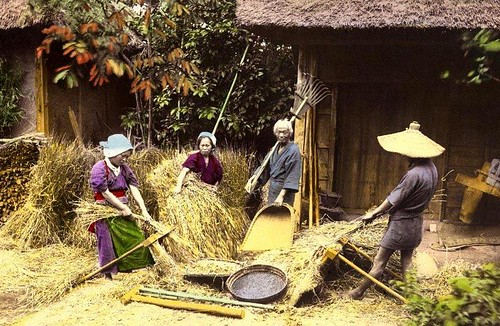
Oh the poor farmers in Japan. You think it's easy to go out into your tiny fields and plant rice? You try it! Nobody in Japan really wants to do it, so farming is left to the aged (average age 65!). Women especially are fleeing the countryside in droves. What happens is that the menfolk – what few young ones are left – then cannot find a marriage partner. Many are "reduced" to ordering brides from abroad, bringing a foreign woman who usually cannot speak any Japanese into the isolation and decline of their farming village.
To top this all off, rice production across the country is dropping and there is pressure from abroad for Japan to open its rice market to imports. Japanese pay more than 10 times what Americans pay for rice, but they still believe that rice cultivation is an important aspect of Japanese culture that needs to be preserved. The Japan Agricultural Cooperative (slogan: Diapers are available in adult sizes at our stores) helps to promote this inefficiency by using its powerful political weight to stop rice imports.
What can be done about this problem?
Move the farmers! Yes, the Japanese government should undertake a massive relocation program for the nation's farmers. Since rural areas are becoming depopulated anyway, the government would simply be speeding up the process and making the transition easier.
But where should they be moved to?
The answer is simple. Move everyone involved in farming to the cities and along major transportation routes where they can plant on small plots of empty land or rooftops of buildings and thus be visible to the urban population. The urban residents, more than 65% and growing, will feel better about the traditions of rice cultivation being upheld. The farmers could even be decked out in traditional "farmer wear" and do all their work by hand (saving on all that imported fuel that powers Japanese agriculture today), giving a more picturesque aspect to their bucolic revival. Traditional thatch roofed houses could be rebuilt in these areas, filling the nation's transportation corridors with a nostalgic, rural Japan theme park!
Since the amount of land cultivated for rice will be dramatically reduced, the shortfall in production will have to be covered by imports. This would be a win-win situation for everyone. Japanese farmers would be able to keep up their timeless activities in a traditional way, but since they would be in or near urban areas, more women would stick around at home and men would not have so much trouble finding brides. In addition, Japan would be able to respond positively to foreign pressure to open its market for imports. The price of rice would fall and the Japanese salaryman would be able to eat his much cheaper, convenience store box lunch on the train while looking out over the classic scenes of Japanese life, a view that hasn't been seen in a century or more! How much better can it get?
To top this all off, rice production across the country is dropping and there is pressure from abroad for Japan to open its rice market to imports. Japanese pay more than 10 times what Americans pay for rice, but they still believe that rice cultivation is an important aspect of Japanese culture that needs to be preserved. The Japan Agricultural Cooperative (slogan: Diapers are available in adult sizes at our stores) helps to promote this inefficiency by using its powerful political weight to stop rice imports.
What can be done about this problem?
Move the farmers! Yes, the Japanese government should undertake a massive relocation program for the nation's farmers. Since rural areas are becoming depopulated anyway, the government would simply be speeding up the process and making the transition easier.
But where should they be moved to?
The answer is simple. Move everyone involved in farming to the cities and along major transportation routes where they can plant on small plots of empty land or rooftops of buildings and thus be visible to the urban population. The urban residents, more than 65% and growing, will feel better about the traditions of rice cultivation being upheld. The farmers could even be decked out in traditional "farmer wear" and do all their work by hand (saving on all that imported fuel that powers Japanese agriculture today), giving a more picturesque aspect to their bucolic revival. Traditional thatch roofed houses could be rebuilt in these areas, filling the nation's transportation corridors with a nostalgic, rural Japan theme park!


Since the amount of land cultivated for rice will be dramatically reduced, the shortfall in production will have to be covered by imports. This would be a win-win situation for everyone. Japanese farmers would be able to keep up their timeless activities in a traditional way, but since they would be in or near urban areas, more women would stick around at home and men would not have so much trouble finding brides. In addition, Japan would be able to respond positively to foreign pressure to open its market for imports. The price of rice would fall and the Japanese salaryman would be able to eat his much cheaper, convenience store box lunch on the train while looking out over the classic scenes of Japanese life, a view that hasn't been seen in a century or more! How much better can it get?
Tuesday, January 25, 2011
Save The Japanese Part 2
Do you remember the angst that swept Japan several years ago when it was discovered that Japanese elementary school children were unable to sharpen their pencils with knives? That precious tradition had been lost, and parents (especially fathers who should get off their butts from in front of the TV and actually interact with their children once in a while!) should spend the time to teach their little ones this valuable cultural lesson. Well... not many fathers got around to it, and now the chickens have come home to roost.
Kyodo News
Friday, January 14
OMG! 1/3 of male teens averse or indifferent to sex
(actual headline in The Daily Yomiuri)
As reported here in an August post, time is running out on our chances to save the Japanese from extinction.
A recent survey done by the Ministry of Health, Labor and Welfare (no less!) has revealed that over 36% of boys between the ages of 16 and 19 are averse or indifferent to sex, more than double the results shown in a similar survey conducted in 2008. That's not all. The same survey revealed that 59% of girls shared their feelings, an uptick of 25%.
"So, what's the connection between pencil sharpening and sex," you ask?
A very pertinent question! In fact, I was preparing to answer it even before you asked.
Remember World War 2? Probably not. OK, let me rephrase that question. Have you read about WW 2 and how brave and tough Japanese were in fighting against the Americans in the Pacific? Does anyone think that your average Japanese – say – high school or college kid could behave like that today? Not in a million years. Why? It is because of the herbivore education that they receive! Of course they learn math and science, reading and writing, and always outscore Americans on any international tests on these subjects, but they miss out on the blood-and-guts, carnivorous parts of education, those parts that get Americans to say things like, "Shoot first, ask questions later," or post signs on their properties that say, "Trespassers will be shot. Survivors will be shot again." Why, 99.99% of Japanese have never even touched a gun, much less fired one.
Never mind guns; they have not even been taught to sharpen a pencil with a knife!
Such is the sad state of Japanese education – cranking out herbivores who have no interest in keeping the Japanese nation viable into the future. It has become even worse than the pandas who at least have zoos and other institutions, watching over them and forcing them to breed in captivity (by showing them panda porn and so on).
Drastic measures need to be taken if we are to keep the Japanese from going extinct. Already their population is slated to fall to around a third of its present level in less than 100 years!
What can we as concerned world citizens do? Have sex with a Japanese? Nuh uh. This will only dilute their Japanese gene pool and make them go extinct even more quickly. What we need to do is help in education. Write to the Ministry of Education, Culture, Sports, Science and Technology in Japan and tell them that you are worried that Japanese are all becoming herbivores and that they should teach more "robust" subjects in schools: Small Animal Butchery in elementary school, for example, or Comparative Porn Around the World in high school classes. "Sports" such as Advanced Petting should be included in the curriculum. Moreover, a more active attitude towards encouraging male–female contact should be promoted. High schools and universities should be required to offer dances and other social events for students. The drinking age should be lowered to 16 as it is in many countries in Europe, and alcohol should be served at these social functions to break down the herbivore inhibitions.
Only through these drastic measures can the Japanese people be saved from going the way of the dinosaur.
Kyodo News
Friday, January 14
OMG! 1/3 of male teens averse or indifferent to sex
(actual headline in The Daily Yomiuri)
As reported here in an August post, time is running out on our chances to save the Japanese from extinction.
A recent survey done by the Ministry of Health, Labor and Welfare (no less!) has revealed that over 36% of boys between the ages of 16 and 19 are averse or indifferent to sex, more than double the results shown in a similar survey conducted in 2008. That's not all. The same survey revealed that 59% of girls shared their feelings, an uptick of 25%.
"So, what's the connection between pencil sharpening and sex," you ask?
A very pertinent question! In fact, I was preparing to answer it even before you asked.
Remember World War 2? Probably not. OK, let me rephrase that question. Have you read about WW 2 and how brave and tough Japanese were in fighting against the Americans in the Pacific? Does anyone think that your average Japanese – say – high school or college kid could behave like that today? Not in a million years. Why? It is because of the herbivore education that they receive! Of course they learn math and science, reading and writing, and always outscore Americans on any international tests on these subjects, but they miss out on the blood-and-guts, carnivorous parts of education, those parts that get Americans to say things like, "Shoot first, ask questions later," or post signs on their properties that say, "Trespassers will be shot. Survivors will be shot again." Why, 99.99% of Japanese have never even touched a gun, much less fired one.
Never mind guns; they have not even been taught to sharpen a pencil with a knife!
Such is the sad state of Japanese education – cranking out herbivores who have no interest in keeping the Japanese nation viable into the future. It has become even worse than the pandas who at least have zoos and other institutions, watching over them and forcing them to breed in captivity (by showing them panda porn and so on).
Drastic measures need to be taken if we are to keep the Japanese from going extinct. Already their population is slated to fall to around a third of its present level in less than 100 years!
What can we as concerned world citizens do? Have sex with a Japanese? Nuh uh. This will only dilute their Japanese gene pool and make them go extinct even more quickly. What we need to do is help in education. Write to the Ministry of Education, Culture, Sports, Science and Technology in Japan and tell them that you are worried that Japanese are all becoming herbivores and that they should teach more "robust" subjects in schools: Small Animal Butchery in elementary school, for example, or Comparative Porn Around the World in high school classes. "Sports" such as Advanced Petting should be included in the curriculum. Moreover, a more active attitude towards encouraging male–female contact should be promoted. High schools and universities should be required to offer dances and other social events for students. The drinking age should be lowered to 16 as it is in many countries in Europe, and alcohol should be served at these social functions to break down the herbivore inhibitions.
Only through these drastic measures can the Japanese people be saved from going the way of the dinosaur.
Tuesday, November 23, 2010
Herbivore Government
I am sure all of you are aware of the territorial conflict between Japan and China over a bunch of tiny islands (Senkaku Shoto in Japanese, Diaoyu in Chinese, and Unchbay Ofay Inytay Islandsay in Pig Latin). Recently this friction over the islands came to a boiling point when a Chinese fishing boat rammed a Japanese Coast Guard vessel which was trying to make that fishing boat stop for illegal entry into Japanese waters.
The Chinese ship was captured, and its crew and captain held in Japan until finally the Japanese let them all go without so much as an apology or compensation from the Chinese government. A video was taken of the Chinese fishing vessel's actions, but it was not released by the Japanese government which was worried that it was too provocative towards the Chinese. The recording was eventually leaked by a Japanese Coast Guard officer (see it here), giving rise to a lot of domestic criticism of the Japanese government for caving in to Chinese pressure.
Yes, it's the herbivore problem at the national level. Forget the samurai legacy, the rip-snorting aggressiveness of old, Japanese leaders have become herbivores.
"Why have they become herbivores," you ask? That is an excellent and timely question! Thank you for asking.
The reason is their wives.
"WHAT?!" You query. "How could their wives have ANYTHING to do with Prime Ministers being herbivores?"
That is also an excellent and timely question. (Please see me after class; I think we should discuss your future as an academic.)
Most Japanese Prime Ministers are – how shall I put this delicately – freaking old. The average age of the last 10 PMs is 63 years old, and they include some of the youngest PMs ever. This also means their wives are older too.
Older women, in their efforts to retain their youthful appearance, use more creams and unguents, some of which have hormones in them. These hormones have been cited as a cause for – shall we say – "unusual" developments in pets. If even pets are changed by their exposure to their owners' creams, imagine what sort of "evolutions" might be caused to the spouses.
"Oh, come on! Surely Japanese Prime Ministers are not hormonized into being herbivores by their wives," you say!
You are not paying attention. Who was the last Japanese PM who had a reputation as an alpha-politician? Koizumi Junichiro. And why was he not a herbivore? He is single!
That is not all. Check out the previous PM, Hatoyama. If he does not have "herbivore" written all over him, I don't know who does!
"But what about the present PM," you ask?
Once again, a timely and pertinent question.
The present PM who would not allow the video of the Chinese fishing vessel ramming Japanese Coast Guard ships to be released, and who sent back captain and crew without conditions is perhaps one of the herbivoriest of recent PMs in Japan, but his fashions are typical politician fuddy-duddy; no indication there.
The key in his case is his wife. You see, he married his first cousin, a marriage that was opposed by both families. So clearly, he married for love rather than for political or other advantages. We can assume that this means that his wife has been touching him more than most political wives touch their hubbies, so the spread of balm-carried hormones is stronger.
"What should be done about this problem," you ask?
Once again, I must commend you on your timely and almost prescient questions!
There is only one solution. The PMs must stop having any physical contact with their wives (or pets). Only through this drastic measure can Japanese leaders regain their testosterone levels and act as manly men in the world arena.
The Chinese ship was captured, and its crew and captain held in Japan until finally the Japanese let them all go without so much as an apology or compensation from the Chinese government. A video was taken of the Chinese fishing vessel's actions, but it was not released by the Japanese government which was worried that it was too provocative towards the Chinese. The recording was eventually leaked by a Japanese Coast Guard officer (see it here), giving rise to a lot of domestic criticism of the Japanese government for caving in to Chinese pressure.
Yes, it's the herbivore problem at the national level. Forget the samurai legacy, the rip-snorting aggressiveness of old, Japanese leaders have become herbivores.
"Why have they become herbivores," you ask? That is an excellent and timely question! Thank you for asking.
The reason is their wives.
"WHAT?!" You query. "How could their wives have ANYTHING to do with Prime Ministers being herbivores?"
That is also an excellent and timely question. (Please see me after class; I think we should discuss your future as an academic.)
Most Japanese Prime Ministers are – how shall I put this delicately – freaking old. The average age of the last 10 PMs is 63 years old, and they include some of the youngest PMs ever. This also means their wives are older too.
Older women, in their efforts to retain their youthful appearance, use more creams and unguents, some of which have hormones in them. These hormones have been cited as a cause for – shall we say – "unusual" developments in pets. If even pets are changed by their exposure to their owners' creams, imagine what sort of "evolutions" might be caused to the spouses.
"Oh, come on! Surely Japanese Prime Ministers are not hormonized into being herbivores by their wives," you say!
You are not paying attention. Who was the last Japanese PM who had a reputation as an alpha-politician? Koizumi Junichiro. And why was he not a herbivore? He is single!
That is not all. Check out the previous PM, Hatoyama. If he does not have "herbivore" written all over him, I don't know who does!
"But what about the present PM," you ask?
Once again, a timely and pertinent question.
The present PM who would not allow the video of the Chinese fishing vessel ramming Japanese Coast Guard ships to be released, and who sent back captain and crew without conditions is perhaps one of the herbivoriest of recent PMs in Japan, but his fashions are typical politician fuddy-duddy; no indication there.
The key in his case is his wife. You see, he married his first cousin, a marriage that was opposed by both families. So clearly, he married for love rather than for political or other advantages. We can assume that this means that his wife has been touching him more than most political wives touch their hubbies, so the spread of balm-carried hormones is stronger.
"What should be done about this problem," you ask?
Once again, I must commend you on your timely and almost prescient questions!
There is only one solution. The PMs must stop having any physical contact with their wives (or pets). Only through this drastic measure can Japanese leaders regain their testosterone levels and act as manly men in the world arena.
Monday, September 13, 2010
The Senior Deficit
Comments from an alert reader and a link to the Creation Museum (Motto: Prepare to Believe) tempt me into another rant, but breaking developments on the missing seniors in Japan (National Motto: We live longer than you do; neener neener neener!) require my attention there.
The news is not encouraging. The Japanese government had previously listed around 45,000 Japanese citizens as being over 100 years old, but the recent push to discover missing seniors has revealed that over 200,000 centenarians have gone missing. Some would be over 150 years old.
Scenario
Scene opens in town office where public pensions are administered.
Watanabe Aho (Director of Records): OK, it's time for our annual review of pension recipients. Let's see... we have 123 people on record here as being over 100 years old! Amazing.
Tanaka Manuke (Assistant Record Keeper) Yes, it truly is amazing. Did you know that once again Japan leads the world in longevity amongst developed nations, according to international reports?
Watanabe: Yes! It fills me with pride. Say...(looking at a chart)... what about this person? His name is Kourei Toshiyori. He was born in 1873! That means that this December, he will be 137 years old!
Tanaka: Yes, he is the only person on our lists who is still receiving military retirement benefits from the Russo-Japanese War. He was in the Imperial Navy, you know.
Watanabe: That is so amazing. And look at this one! Ojii Shinisou. Our records show that he was born in 1890.
Tanaka: (checking the computer) Yes, I visited his family only last month to wish him a happy 120th birthday, but – wouldn't you know it – he was napping and couldn't receive any guests.
Watanabe: (chuckling) Yeah, well seniors that old deserve their naps! My data shows that he was around during the occupation of Korea in 1910! It says here that he was on Vice Admiral Chuichi Nagumo's staff during the Pearl Harbor attack! Imagine all that he has seen and done in his long life!
Tanaka: Yes, it is truly astounding.
Watanabe: He has been receiving his government pension now for 55 years. It is the least our society can do for someone who has given so much to our country over these many years.
Tanaka: Truly. Look at this one! Oh my god! I knew that women lived longer than men in general, but this one is remarkable. Her name is Koukourei Miira. She was born in – get this – 1855! She is 155 years old this year!
Watanabe: Yes, I went to her house last – let me see – last January to give her our special award for longevity. She is the oldest person in our district you know! Unfortunately, her family said she was napping and could not be disturbed, but they accepted the award on her behalf.
Tanaka: (looking at the computer again) Awww... that is so sweet. Did you know that she was a witness to the Meiji Restoration! Remarkable.
Watanabe: (putting the files back into their cabinets) OK, it looks like all these people check out. Let's look at the 90-year-olds now, OK?
Tanaka: Good idea, we can't be too careful with the public's money, can we.
The news is not encouraging. The Japanese government had previously listed around 45,000 Japanese citizens as being over 100 years old, but the recent push to discover missing seniors has revealed that over 200,000 centenarians have gone missing. Some would be over 150 years old.
Scenario
Scene opens in town office where public pensions are administered.
Watanabe Aho (Director of Records): OK, it's time for our annual review of pension recipients. Let's see... we have 123 people on record here as being over 100 years old! Amazing.
Tanaka Manuke (Assistant Record Keeper) Yes, it truly is amazing. Did you know that once again Japan leads the world in longevity amongst developed nations, according to international reports?
Watanabe: Yes! It fills me with pride. Say...(looking at a chart)... what about this person? His name is Kourei Toshiyori. He was born in 1873! That means that this December, he will be 137 years old!
Tanaka: Yes, he is the only person on our lists who is still receiving military retirement benefits from the Russo-Japanese War. He was in the Imperial Navy, you know.
Watanabe: That is so amazing. And look at this one! Ojii Shinisou. Our records show that he was born in 1890.
Tanaka: (checking the computer) Yes, I visited his family only last month to wish him a happy 120th birthday, but – wouldn't you know it – he was napping and couldn't receive any guests.
Watanabe: (chuckling) Yeah, well seniors that old deserve their naps! My data shows that he was around during the occupation of Korea in 1910! It says here that he was on Vice Admiral Chuichi Nagumo's staff during the Pearl Harbor attack! Imagine all that he has seen and done in his long life!
Tanaka: Yes, it is truly astounding.
Watanabe: He has been receiving his government pension now for 55 years. It is the least our society can do for someone who has given so much to our country over these many years.
Tanaka: Truly. Look at this one! Oh my god! I knew that women lived longer than men in general, but this one is remarkable. Her name is Koukourei Miira. She was born in – get this – 1855! She is 155 years old this year!
Watanabe: Yes, I went to her house last – let me see – last January to give her our special award for longevity. She is the oldest person in our district you know! Unfortunately, her family said she was napping and could not be disturbed, but they accepted the award on her behalf.
Tanaka: (looking at the computer again) Awww... that is so sweet. Did you know that she was a witness to the Meiji Restoration! Remarkable.
Watanabe: (putting the files back into their cabinets) OK, it looks like all these people check out. Let's look at the 90-year-olds now, OK?
Tanaka: Good idea, we can't be too careful with the public's money, can we.
Saturday, August 14, 2010
Monday, August 9, 2010
Longevity in Japan
It's well known that Japanese have one of the longest life expectancies in the world. There are many people around in their 70s and 80s and even 90-year-olds are not that uncommon. People who live to be 100 years old – passing the century mark – are often singled out by their communities for recognition. A social worker or someone from city hall will come around, bringing a small gift to recognize the remarkable achievement in long life.
Of course, often the elderly centenarians cannot come to the door to receive their award. After all, being 100 years old is no picnic. The old people might be napping. They might be ill and bed ridden. They might be dead.
Dead?
Alas, yes. Mr. Kato a resident of Suginami Ward in Tokyo reached the remarkable age of 111 years old this year. Welfare workers from the ward office wanted to visit this amazing man to present him with a small token of their appreciation of his being the oldest man in the entire city of Tokyo. Regrettably, according to his daughter, he was unable to come to the door on account of being bed ridden. They came back another time. Unfortunately, the poor man still could not make it to the door. They returned another time determined to recognize him for being the oldest man in the whole city of Tokyo. Once again, his daughter said he was not up to receiving visitors.
This made the ward officials suspicious, and they went to the police. The police – not bringing an award – forced their way into the house and discovered the reason for Mr. Kato's inability to receive guests. He was dead. Not only dead, but mummified. The police found newspapers scattered about his room with dates from 30 years previous. It seems that Mr. Kato had not lived to be 111, but more like 81. The family is being investigated for pension fraud.
Ah, the bad apples that spoil the barrel. What is to be done about them?
The officials in Suginami Ward (obviously a hotbed of longevity) shook their heads in disbelief. "It's isolated incidents like this that give everyone the wrong impression about longevity in Tokyo!"
Another day. Suginami Ward officials head out to pay their respects and give recognition to Ms. Furuya who, at 113 years old, is the oldest woman in Tokyo. Greeted at the door by her daughter, they discover that Ms. Furuya does not live there anymore. Despite the centenarian being registered at that address, the daughter claims that her elderly mother has not lived there for years, but is living with her brother with whom she has no contact. Upon investigation, authorities find that the house where the brother was supposed to be living had been torn down to make way for a highway. When they catch up with him later, he claims to have no knowledge of his mother either.
Uh oh. Suddenly everyone over 100 is suspect of not being over 100 anymore. Orders have been sent out, and now (even in the rural prefecture where we live, Niigata) social workers are going door-to-door to check on the welfare of the centenarians in their communities. As of tonight, no "missing" 100-year-olds have been discovered here in Niigata, but around the country? Nearly 200 centenarians remain unaccounted for.
Are you thinking what I am thinking?
No, not THAT thought!
The one about the 90-year-olds. That one.
Maybe a lot of them are missing too?
But on another note, Japan has long been concerned about the aging of its population and how the proportion of elderly folks is so high relative to the number of young people who are working to pay the way. Good news for the workers: there may not be so many old people after all!
Of course, often the elderly centenarians cannot come to the door to receive their award. After all, being 100 years old is no picnic. The old people might be napping. They might be ill and bed ridden. They might be dead.
Dead?
Alas, yes. Mr. Kato a resident of Suginami Ward in Tokyo reached the remarkable age of 111 years old this year. Welfare workers from the ward office wanted to visit this amazing man to present him with a small token of their appreciation of his being the oldest man in the entire city of Tokyo. Regrettably, according to his daughter, he was unable to come to the door on account of being bed ridden. They came back another time. Unfortunately, the poor man still could not make it to the door. They returned another time determined to recognize him for being the oldest man in the whole city of Tokyo. Once again, his daughter said he was not up to receiving visitors.
This made the ward officials suspicious, and they went to the police. The police – not bringing an award – forced their way into the house and discovered the reason for Mr. Kato's inability to receive guests. He was dead. Not only dead, but mummified. The police found newspapers scattered about his room with dates from 30 years previous. It seems that Mr. Kato had not lived to be 111, but more like 81. The family is being investigated for pension fraud.
Ah, the bad apples that spoil the barrel. What is to be done about them?
The officials in Suginami Ward (obviously a hotbed of longevity) shook their heads in disbelief. "It's isolated incidents like this that give everyone the wrong impression about longevity in Tokyo!"
Another day. Suginami Ward officials head out to pay their respects and give recognition to Ms. Furuya who, at 113 years old, is the oldest woman in Tokyo. Greeted at the door by her daughter, they discover that Ms. Furuya does not live there anymore. Despite the centenarian being registered at that address, the daughter claims that her elderly mother has not lived there for years, but is living with her brother with whom she has no contact. Upon investigation, authorities find that the house where the brother was supposed to be living had been torn down to make way for a highway. When they catch up with him later, he claims to have no knowledge of his mother either.
Uh oh. Suddenly everyone over 100 is suspect of not being over 100 anymore. Orders have been sent out, and now (even in the rural prefecture where we live, Niigata) social workers are going door-to-door to check on the welfare of the centenarians in their communities. As of tonight, no "missing" 100-year-olds have been discovered here in Niigata, but around the country? Nearly 200 centenarians remain unaccounted for.
Are you thinking what I am thinking?
No, not THAT thought!
The one about the 90-year-olds. That one.
Maybe a lot of them are missing too?
But on another note, Japan has long been concerned about the aging of its population and how the proportion of elderly folks is so high relative to the number of young people who are working to pay the way. Good news for the workers: there may not be so many old people after all!
Subscribe to:
Posts (Atom)