As a hard-hitting news hound, I have reported here before about the National Police Agency (NPA Japan) and its battle with organized crime, the Yakuza (Japanese mafia). As I discovered, part of the NPA's serious effort has been to actively compete with the gangs for revenue as a way of reducing the flow of money into the coffers of the "bad guys".
With the 2020 Olympics scheduled to take place in Tokyo, organized crime is seeing a growth of opportunities for increasing its income. There are enormous construction projects to be parceled out, workers to be hired, sex workers to be enrolled and heaps of money to be made in shakedowns, extortion, kickbacks and out-and-out bribes.
Clearly the NPA cannot let all this go unchallenged and has to take a stand against organized crime by taking over many of these "businesses" for themselves.
No, I am not making this up.
I usually spend most of my time yucking it up in these posts, but sometimes it is important to probe and investigate – as the hard-hitting news hound that I am – to get to the bottom of the story and expose the behind-the-scenes information that I know you readers have come to depend on from me.
Once again, I arranged an interview with Assistant Vice-Director of Vice Control Lieutenant Wairo at the NPA.
Lt. Wairo (still dressed in his distinctive style): Oh, it's you again. Didn't you come and interview me a couple of years ago?
P: Yes, I did. We talked about the NPA's competition with organized crime for money from illegal businesses.
Lt. Wairo: Oh, right! I remember now. What can I do for you today?
P: Recently, I read that the NPA is once again trying to force the Yakuza to the sidelines by directly competing for positions in construction companies that will be building Olympic venues for the 2020 Tokyo Olympics.
Lt. Wairo: Yes? And?
P: Well, I was hoping you could explain why the NPA is essentially moving to take over Yakuza activities that normally would be suppressed by many police agencies.
Lt. Wairo (sighing elaborately and stubbing his non-filter cigarette out abruptly) : I explained all this the last time you came here, but the Olympic decision definitely puts a new spin on things. Here in the NPA we have a lot of old-timers – basically, your baby-boomers (he looks at me meaningfully) – who are retiring in droves. Traditionally we have found post-retirement positions for them as advisers in the highway-sign companies and illegal gambling industry, but even though we are trying hard to increase signage and pushing for allowing casinos to operate, we still do not have enough openings for these retirees. The construction boom that is sure to take place here in Tokyo is obviously a good place for us to start.
P: Yes, you do need to find positions for these people, don't you.
Lt. Wairo: Exactly! And what better way to do it than to push the gangsters out at the same time! It's a win-win situation! Our retirees get their post-retirement positions that assure well-deserved comfort in their golden years, AND (he thumps his desk with his fist) we edge out the bad guys who would otherwise be in these positions, funneling money into organized crime!
P: Yes. Why let the gangsters get the bribes and kickbacks for deciding which companies get projects when your retirees can receive these funds!
Lt. Wairo (beaming): Indeed! And here I thought you were not so bright!
Our efforts to take over these anti-social activities from people we really don't want in our communities should receive a major boost from the Olympics. Even the other businesses we talked about when you came last time should be thriving with the influx of tourists from around the world!
P: You mean the sex industry and gambling?
Lt. Wairo: Ha ha! You foreigners are so direct. We don't call it the "sex industry"; you make it sound so sleazy. What could be more beneficial to an Olympic tourist after a hard day of cheering on his country's teams than to relax in one of our managed soapland spas? Or they could head out for some excitement at one of the new casinos we hope to have in place by then?
P: Of course! And they could go to all these places without worrying that they were contributing to the advancement of organized crime.
Lt. Wairo: I am pleased that you see it that way!
Hey, before you go... I hear that you were a professor of English language. Is that correct?
P: Er.... yes?
Lt. Wairo (pulling a poster, advertising a soapland "spa" out of his desk): Well, with the Olympics coming, all of these ads and posters will have to be translated into English, so I was wondering if you could do us a favor and translate them for us? You can start with this one. We would be happy to pay you for your time, and (winking) you could go to the soapland yourself to do some "research". Of course your visit would be "on the house"! (he laughs suggestively)
P: Oh... well, I would love to of course, but actually I'm pretty busy these days. I am sure you have people in the police department who can handle the translation. Why not get one of the guys who translates your highway signs* to do it?
Lt. Wairo: OK, good idea, but if you change your mind, don't hesitate to contact me again!
P: Thank you, and thank you for your time.
Lt. Wairo: We here at the National Police Agency are always delighted to talk to members of the international press.
- - - - - - - - - -
* A better translation would be "Motor Vehicles Only". One sign costs ¥25,000,000 or about USD$250,000! There are probably hundreds of these signs around the country.
Showing posts with label win-win solutions. Show all posts
Showing posts with label win-win solutions. Show all posts
Monday, October 14, 2013


Monday, September 9, 2013
Brain Health Through Messiness
We guys pretty much understand that we are hard to live with. I have written about this before, trying to persuade the "fairer" sex that we men are worth keeping around, but it isn't easy.
We monopolize the remote control. We do all of our chores in a slovenly and ill-timed manner. We leave our clothes lying around. We forget to clean up after friends come over, leaving YOU to put all the wine bottles and beer cans in the recycling bin, and I don't even want to talk about the crumbs and bits of pizza that end up soiling the carpet and falling down behind the cushion in the sofa (I swear that was not MY piece of pizza!).
Let's face it. Men are slobs.
Which brings me to my point, a delicate issue. First of all, I am really not trying to defend our behavior as such. Rather, I would like to make a point that maybe women could consider... you know... think about.
I stumbled upon this information recently about Alzheimer's. Apparently people who live in clean and hygienic places suffer from this disease more than those who do not live in such germ-free environments. The lack of exposure to infectious agents, dirt and grit seems to have some connection to the later development of this debilitating mental disease.
Another interesting feature of this incapacitation is that women get it more than men. There are a lot of theories about why they do, but the fact of it is undeniable.
I think that the "theorists" may be missing a key component in the difference of lifestyle between women and guys that may be hiding the real culprit behind the increased risk. It seems entirely possible to me that women, being neat and tidy and generally preferring to clean up everything right away might be sowing the seeds of their own later problems.
We guys live like pigs (sorry pigs), and this lack of interest in basic hygiene may actually protect us from the onset of this form of dementia. When we forget to wash our hands after changing the oil in the lawn mower or – shudder – going to the toilet, we may actually be promoting better brain health.
So what I am trying to suggest, women, is that maybe you guys could lighten up about the cleanliness around the house a little and not only benefit from the possibility of better brain health in later years but also get along with us guys better.
We monopolize the remote control. We do all of our chores in a slovenly and ill-timed manner. We leave our clothes lying around. We forget to clean up after friends come over, leaving YOU to put all the wine bottles and beer cans in the recycling bin, and I don't even want to talk about the crumbs and bits of pizza that end up soiling the carpet and falling down behind the cushion in the sofa (I swear that was not MY piece of pizza!).
Let's face it. Men are slobs.
Which brings me to my point, a delicate issue. First of all, I am really not trying to defend our behavior as such. Rather, I would like to make a point that maybe women could consider... you know... think about.
I stumbled upon this information recently about Alzheimer's. Apparently people who live in clean and hygienic places suffer from this disease more than those who do not live in such germ-free environments. The lack of exposure to infectious agents, dirt and grit seems to have some connection to the later development of this debilitating mental disease.
Another interesting feature of this incapacitation is that women get it more than men. There are a lot of theories about why they do, but the fact of it is undeniable.
I think that the "theorists" may be missing a key component in the difference of lifestyle between women and guys that may be hiding the real culprit behind the increased risk. It seems entirely possible to me that women, being neat and tidy and generally preferring to clean up everything right away might be sowing the seeds of their own later problems.
We guys live like pigs (sorry pigs), and this lack of interest in basic hygiene may actually protect us from the onset of this form of dementia. When we forget to wash our hands after changing the oil in the lawn mower or – shudder – going to the toilet, we may actually be promoting better brain health.
So what I am trying to suggest, women, is that maybe you guys could lighten up about the cleanliness around the house a little and not only benefit from the possibility of better brain health in later years but also get along with us guys better.
Monday, February 11, 2013
Daioyu Dilemma and the Senkaku Solution
Most of you are not aware of it, but I majored in Political Science at university (along with a minor in chess and ... um... herbal therapy). My interest in international politics remains keen, and while I usually try to yuck it up here in these posts, sometimes I like to apply my expertise and long experience to the problems of the day, coming to a thoughtful solution.
One does like to be helpful.
As you must know by now, the Chinese and the Japanese have been exchanging unpleasantries over a group of tiny islands north of Taiwan. The Chinese refer to these islands as the Daioyu, while the Japanese call them the Senkaku Islands.
The Chinese lay claim to them because they appear on maps from ancient times.
The Japanese, for their part, insist on their rights to the islands partly because the Chinese signed them away to the Japanese. Japanese have lived on the islands in modern times; there is no evidence that Chinese ever lived there.
Basically, each country has a claim to them, and now that it seems there might be large natural gas or oil reserves under them, both countries would like to strengthen their rights to mine them.
The nastiness took a turn for the worst this past week with Japan claiming that Chinese warships "painted" Japanese warships with their fire-control radar, clearly an aggressive act. The Chinese deny it, naturally, but the unpleasantness has now taken on a darker hue.
The Daioyu/Senkaku Islands, what are we talking about here? First, they are made up of several little islands and rocky outcrops, none of which amounts to very much. The total land area is 7 km² (2.7 mi²).
"How big is that," you ask?
Thank you for asking, because I went to a lot of trouble to come up with some comparisons that would make sense to a variety of people. Their total land area is roughly double the area of Central Park in New York City, for example.
Never been to New York? They are a little over three times as big as Hyde Park in London or a third the size of Richmond Park in that same city. Their land area is a little larger than Lane Cove Park in the Sydney area, one third the size of tiny Iwo Jima, the island fought over during World War II. They are as big as 1307 American football fields (including the end zones) or 980 average soccer pitches. A chunk of Greenland ice of the same size just broke off and fell into the sea.
Anyway, you get the picture. We are not talking about a huge land mass here.
So what can be done about this problem? How can the "It's mine!" "No, it's mine!!" back and forth between Japan and China be resolved?
No, giving them to North Korea is not an option.
In the interest of world peace and win-win solutions to world problems, I have racked my brains to come up with a reasonable solution. The issue that puts a wrench into any diplomatic resolution seems to be the existence of the islands themselves.
"Duh!" You say? "Of course the islands are the problem! Moron!"
Yes, exactly, and I really don't like your attitude.
If you think about it, two important countries are at the edge of conflict over tiny scraps of land out in the middle of the ocean, islands. According to international law, an island is defined as any land that remains above water at high tide, lands that are partially covered at high tide are called "shoals" or "rocks".
The solution to this island problem is obvious. The islands need to be removed.
"HAHAHA!! Moron! You can't remove the islands!" I hear you laughing all the way over here in Japan, and I am really not liking you or your attitude.
Remember what we are talking about here. Only one island stands very high above sea level, Uotsuri-jima with a tall peak on it that reaches 383 meters (1256 ft.). In terms of earth volume they are not that great. Japan, for example, has moved enough earth to build two artificial islands in Kobe harbor, Port Island, built from 1966 to 1981 with an area of 5.23 km² (2 mi²), and Rokko Island, built between 1973 and 1992 with an area of 5.8 km² (2.24 mi²). The total amount of land area is significantly larger than that of the Senkaku Islands. In the United States, the huge Hull-Rust-Mahoning Open Pit Iron Mine in Minnesota covers an area of 13.6 km² (5.25 mi²) almost double the area of the Senkaku Islands, and with a depth in places of almost 200 meters (600 ft.), the amount of earth removed dwarfs the amount that would need to be scoured from the islands.
Removing the islands would be a big project; the removed earth would have to be dispersed locally. The waters are not very deep at about 100 to 150 meters, but there is plenty of room to spread the rock and other island debris so that it does not come above sea level at low tide.
Once removed, the area would be open sea, away from territorial claims by either Japan or China. As part of the island removal plan, an agreement could be reached to jointly develop the resources that might lie below. The former islands, then well below low tide levels, could be used as close-to-the-surface platform bases for oil rig placements. The resource exploration costs could be split 50/50 and any resources developed could be split similarly.
A contentious issue can be resolved in a win-win way for both sides, contributing to area peace and stability.
A Nobel Peace Prize nomination might be in the offing!
And now for the Palestine-Israeli problem... I guess bulldozing them into the sea might be a bit much technologically. You think?
One does like to be helpful.
As you must know by now, the Chinese and the Japanese have been exchanging unpleasantries over a group of tiny islands north of Taiwan. The Chinese refer to these islands as the Daioyu, while the Japanese call them the Senkaku Islands.
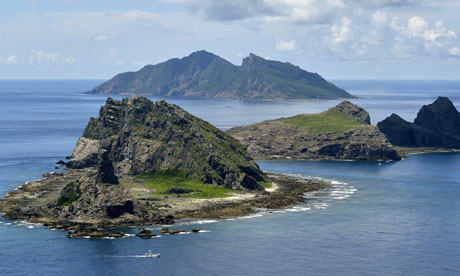
The Chinese lay claim to them because they appear on maps from ancient times.
The Japanese, for their part, insist on their rights to the islands partly because the Chinese signed them away to the Japanese. Japanese have lived on the islands in modern times; there is no evidence that Chinese ever lived there.
Basically, each country has a claim to them, and now that it seems there might be large natural gas or oil reserves under them, both countries would like to strengthen their rights to mine them.
The nastiness took a turn for the worst this past week with Japan claiming that Chinese warships "painted" Japanese warships with their fire-control radar, clearly an aggressive act. The Chinese deny it, naturally, but the unpleasantness has now taken on a darker hue.
The Daioyu/Senkaku Islands, what are we talking about here? First, they are made up of several little islands and rocky outcrops, none of which amounts to very much. The total land area is 7 km² (2.7 mi²).
"How big is that," you ask?
Thank you for asking, because I went to a lot of trouble to come up with some comparisons that would make sense to a variety of people. Their total land area is roughly double the area of Central Park in New York City, for example.
Never been to New York? They are a little over three times as big as Hyde Park in London or a third the size of Richmond Park in that same city. Their land area is a little larger than Lane Cove Park in the Sydney area, one third the size of tiny Iwo Jima, the island fought over during World War II. They are as big as 1307 American football fields (including the end zones) or 980 average soccer pitches. A chunk of Greenland ice of the same size just broke off and fell into the sea.
Anyway, you get the picture. We are not talking about a huge land mass here.
So what can be done about this problem? How can the "It's mine!" "No, it's mine!!" back and forth between Japan and China be resolved?
No, giving them to North Korea is not an option.
In the interest of world peace and win-win solutions to world problems, I have racked my brains to come up with a reasonable solution. The issue that puts a wrench into any diplomatic resolution seems to be the existence of the islands themselves.
"Duh!" You say? "Of course the islands are the problem! Moron!"
Yes, exactly, and I really don't like your attitude.
If you think about it, two important countries are at the edge of conflict over tiny scraps of land out in the middle of the ocean, islands. According to international law, an island is defined as any land that remains above water at high tide, lands that are partially covered at high tide are called "shoals" or "rocks".
The solution to this island problem is obvious. The islands need to be removed.
"HAHAHA!! Moron! You can't remove the islands!" I hear you laughing all the way over here in Japan, and I am really not liking you or your attitude.
Remember what we are talking about here. Only one island stands very high above sea level, Uotsuri-jima with a tall peak on it that reaches 383 meters (1256 ft.). In terms of earth volume they are not that great. Japan, for example, has moved enough earth to build two artificial islands in Kobe harbor, Port Island, built from 1966 to 1981 with an area of 5.23 km² (2 mi²), and Rokko Island, built between 1973 and 1992 with an area of 5.8 km² (2.24 mi²). The total amount of land area is significantly larger than that of the Senkaku Islands. In the United States, the huge Hull-Rust-Mahoning Open Pit Iron Mine in Minnesota covers an area of 13.6 km² (5.25 mi²) almost double the area of the Senkaku Islands, and with a depth in places of almost 200 meters (600 ft.), the amount of earth removed dwarfs the amount that would need to be scoured from the islands.
Removing the islands would be a big project; the removed earth would have to be dispersed locally. The waters are not very deep at about 100 to 150 meters, but there is plenty of room to spread the rock and other island debris so that it does not come above sea level at low tide.
Once removed, the area would be open sea, away from territorial claims by either Japan or China. As part of the island removal plan, an agreement could be reached to jointly develop the resources that might lie below. The former islands, then well below low tide levels, could be used as close-to-the-surface platform bases for oil rig placements. The resource exploration costs could be split 50/50 and any resources developed could be split similarly.
A contentious issue can be resolved in a win-win way for both sides, contributing to area peace and stability.
A Nobel Peace Prize nomination might be in the offing!
And now for the Palestine-Israeli problem... I guess bulldozing them into the sea might be a bit much technologically. You think?
Monday, October 29, 2012
Memory Slime
In this day of increasingly aging populations and demographic downturns, societies look for ways to enhance the lives of their citizens, hoping to make them longer and healthier. We have discussed senior mental health in these posts on a number of occasions, and I want to post helpful links to all of them here, but I think I deleted my list or maybe left it in the freezer or somewhere*.
While I have discussed how to deal with temporary memory loss and what to avoid in your daily life that makes you appear to be senile or even dead, I have not really talked much about the cutting edge research that is going on with slime molds.
Now, I know what you are thinking. "What does slime mold have to do with our aging minds and memory loss?!"
That is an excellent thought, and I suggest for starters that you write it down before you forget it. Write it on something large like a coffee table, so that you will not inadvertently put it through the wash or leave it in the oven.
While you are jotting that down, let me continue to explain about this cutting edge research. Humans have big brains and in addition to being highly intelligent as shown by results of the Wechsler Adult Intelligence Scale (WAIS), they also have excellent abilities to think about the future and dwell on the past. In other words, our temporal awareness is very advanced. Cats, on the other hand, while having brains very similar to our own, score very low on the WAIS test mostly due to lack of interest and general lethargy. Holding the pencil also proved challenging. But through persistent research, scientists have come to the conclusion that cats have only about a 16-hour working memory. This seems to indicate that brain size itself may correlate well with memory.
Imagine the shock then amongst scientists when they discovered that something that does not actually HAVE a brain nevertheless still has memory. Slime molds are very low on the evolutionary ladder and do not actually have a brain. But they CAN remember where they have been! This may seem like a pathetically simple process, but when you consider how many people you have seen wandering around in mall parking lots looking for their cars, you can see that remembering where you have been is indeed an important mental skill.
So how do the slime molds do it? Apparently they leave a trail of slime, their slime, behind them as they move, marking the routes they have taken. The trail of slime allows them to determine what – if anything – is at its end. If there is the sugar placed there by the scientists, they will "remember" that and follow the trail back to their reward.
How does this apply to us?
It is a well-known fact that human tissues can be cultivated on animals, so the ability to manipulate genetic material is already well established. What needs to be done to solve senior memory problems is the reverse. Genetic material from creatures who remember without brains needs to be transferred to humans to enable us to "get around" our mental problems and access other ways of remembering where our car is, for example. The ability to leave a slime trail back to your car would be incredibly beneficial to many seniors who go to great lengths to make their cars conspicuous (think flags, ribbons and even small teddy bears on the aerial) but then exit the mall on the wrong side and wander around for hours in the hot sun.
I know what you are thinking again. "But humans don't make slime, silly!"
Except for the "silly" part, your point is well taken. Indeed, humans do not make slime. However, we often DO carry around a lot of excess weight in the form of blubber. Through the wonder of genetic engineering, this blubber could easily be converted to slime which could ooze from – say – the pores in our lower legs, leaving a trail back to the car in the parking lot. This would not only empower us to "remember" important things even though our brains were aging, but it would also enable us to "burn off" those excess calories – truly a win-win situation.
- - - - - - - - - -
*I found the list in my hand!
Mental-Health Tips for Seniors
Five Ways Not to be Dead
Forever Young
Across the Event Boundary Backwards
Dieting Made Easy
Voice-Activate Your Memory Chips
Your Second Wind
Pussies Riot and Seniors Snooze
The Brain Bane of Memory
While I have discussed how to deal with temporary memory loss and what to avoid in your daily life that makes you appear to be senile or even dead, I have not really talked much about the cutting edge research that is going on with slime molds.
Now, I know what you are thinking. "What does slime mold have to do with our aging minds and memory loss?!"
That is an excellent thought, and I suggest for starters that you write it down before you forget it. Write it on something large like a coffee table, so that you will not inadvertently put it through the wash or leave it in the oven.
While you are jotting that down, let me continue to explain about this cutting edge research. Humans have big brains and in addition to being highly intelligent as shown by results of the Wechsler Adult Intelligence Scale (WAIS), they also have excellent abilities to think about the future and dwell on the past. In other words, our temporal awareness is very advanced. Cats, on the other hand, while having brains very similar to our own, score very low on the WAIS test mostly due to lack of interest and general lethargy. Holding the pencil also proved challenging. But through persistent research, scientists have come to the conclusion that cats have only about a 16-hour working memory. This seems to indicate that brain size itself may correlate well with memory.
Imagine the shock then amongst scientists when they discovered that something that does not actually HAVE a brain nevertheless still has memory. Slime molds are very low on the evolutionary ladder and do not actually have a brain. But they CAN remember where they have been! This may seem like a pathetically simple process, but when you consider how many people you have seen wandering around in mall parking lots looking for their cars, you can see that remembering where you have been is indeed an important mental skill.
So how do the slime molds do it? Apparently they leave a trail of slime, their slime, behind them as they move, marking the routes they have taken. The trail of slime allows them to determine what – if anything – is at its end. If there is the sugar placed there by the scientists, they will "remember" that and follow the trail back to their reward.
How does this apply to us?
It is a well-known fact that human tissues can be cultivated on animals, so the ability to manipulate genetic material is already well established. What needs to be done to solve senior memory problems is the reverse. Genetic material from creatures who remember without brains needs to be transferred to humans to enable us to "get around" our mental problems and access other ways of remembering where our car is, for example. The ability to leave a slime trail back to your car would be incredibly beneficial to many seniors who go to great lengths to make their cars conspicuous (think flags, ribbons and even small teddy bears on the aerial) but then exit the mall on the wrong side and wander around for hours in the hot sun.
I know what you are thinking again. "But humans don't make slime, silly!"
Except for the "silly" part, your point is well taken. Indeed, humans do not make slime. However, we often DO carry around a lot of excess weight in the form of blubber. Through the wonder of genetic engineering, this blubber could easily be converted to slime which could ooze from – say – the pores in our lower legs, leaving a trail back to the car in the parking lot. This would not only empower us to "remember" important things even though our brains were aging, but it would also enable us to "burn off" those excess calories – truly a win-win situation.
- - - - - - - - - -
*I found the list in my hand!
Mental-Health Tips for Seniors
Five Ways Not to be Dead
Forever Young
Across the Event Boundary Backwards
Dieting Made Easy
Voice-Activate Your Memory Chips
Your Second Wind
Pussies Riot and Seniors Snooze
The Brain Bane of Memory
Monday, June 18, 2012
Our Big Fat Fuel Future
Before I get started here, I should say that I grew up in a foreign country and have missed out on a lot of popular culture in the US. Imagine my surprise then to discover that Beaver Cleaver was a child actor in a late 1950s comedy show and not a porn star!
Who could have guessed?
Anyway, according to the Center for Disease Control, 35.7% of Americans are obese. The news media is awash in articles and reports about how serious a health problem this presents to us as a nation and wrings its hands over what steps we can take to solve it.
It's easy to get sucked into this debate about health concerns, while ignoring the fact that there may be pluses to the growing waistlines of the American population. In an article last year, I promoted green energy through the mining of America's rich, untapped fuel-resource, fat.
There is no question that with rising gasoline prices and increasing dependence for oil on an unstable region of the world, this sort of forward-thinking is necessary to our future security and progress as a nation.
But that is not enough.
Scientists at Stanford University have developed a technique for turning fat into stem cells. Working with donated fat ("an abundant natural resource and a renewable one," according to surgeon Michael Longaker) scientists have used cutting-edge medical techniques to transform fat cells into stem cells. Stem cells are primitive cells which can be triggered to develop into any type of cell in the body. If your heart is failing, for example, in theory a stem-cell could be prodded into providing new heart muscle tissue which could be used to replace damaged parts of your heart, giving you a new lease on life. This means that the so-called moral issues of using embryonic stem cells from unused human embryos can be dodged. Moreover anyone can provide the "resources" for one's own stem-cell therapy, thereby avoiding tissue rejection problems.
Do you realize what this means?
As I explained in another article, the United States is collectively carrying around the total body weight of two Swedens in extra fat. While 5.28 billion pounds or 2.4 billion kilograms overweight may seem like a lot, in terms of total consumption, it doesn't go very far. The US daily consumption of oil is 18,690,000 barrels per day. Each barrel weighs in at 305 lbs (138.8 kg), so the total weight of oil consumed each day is around 5.7 billion lbs or 2.6 billion kilograms. Though I am not good at math, even I can tell that if we pumped all the fat that America has to spare, we would not have enough to cover even one day of our total oil consumption. People would be thinner, but houses would be cold; cars would run out of gas on the roads.
Clearly, simple extraction will not solve our fuel crisis or bring us closer to energy independence. If these fat-derived stem cells can be turned into any kind of human cell, it means that they can also be turned into more fat cells! Using this new breakthrough technology developed at Stanford University, we can use fat cells to grow more fat cells! According to the National Institutes of Health, one stem cell can be grown into millions – yes millions – of other cells which are themselves self-proliferating. If our total fat resources today can almost provide one day of oil consumption, having the ability to increase this amount by – say – even a thousand fold will insure that America can limit its reliance on fossil fuels, thereby reducing its carbon footprint with green energy, and finally achieving energy independence for a better tomorrow.
Who could have guessed?
Anyway, according to the Center for Disease Control, 35.7% of Americans are obese. The news media is awash in articles and reports about how serious a health problem this presents to us as a nation and wrings its hands over what steps we can take to solve it.
It's easy to get sucked into this debate about health concerns, while ignoring the fact that there may be pluses to the growing waistlines of the American population. In an article last year, I promoted green energy through the mining of America's rich, untapped fuel-resource, fat.
There is no question that with rising gasoline prices and increasing dependence for oil on an unstable region of the world, this sort of forward-thinking is necessary to our future security and progress as a nation.
But that is not enough.
Scientists at Stanford University have developed a technique for turning fat into stem cells. Working with donated fat ("an abundant natural resource and a renewable one," according to surgeon Michael Longaker) scientists have used cutting-edge medical techniques to transform fat cells into stem cells. Stem cells are primitive cells which can be triggered to develop into any type of cell in the body. If your heart is failing, for example, in theory a stem-cell could be prodded into providing new heart muscle tissue which could be used to replace damaged parts of your heart, giving you a new lease on life. This means that the so-called moral issues of using embryonic stem cells from unused human embryos can be dodged. Moreover anyone can provide the "resources" for one's own stem-cell therapy, thereby avoiding tissue rejection problems.
Do you realize what this means?
As I explained in another article, the United States is collectively carrying around the total body weight of two Swedens in extra fat. While 5.28 billion pounds or 2.4 billion kilograms overweight may seem like a lot, in terms of total consumption, it doesn't go very far. The US daily consumption of oil is 18,690,000 barrels per day. Each barrel weighs in at 305 lbs (138.8 kg), so the total weight of oil consumed each day is around 5.7 billion lbs or 2.6 billion kilograms. Though I am not good at math, even I can tell that if we pumped all the fat that America has to spare, we would not have enough to cover even one day of our total oil consumption. People would be thinner, but houses would be cold; cars would run out of gas on the roads.
Clearly, simple extraction will not solve our fuel crisis or bring us closer to energy independence. If these fat-derived stem cells can be turned into any kind of human cell, it means that they can also be turned into more fat cells! Using this new breakthrough technology developed at Stanford University, we can use fat cells to grow more fat cells! According to the National Institutes of Health, one stem cell can be grown into millions – yes millions – of other cells which are themselves self-proliferating. If our total fat resources today can almost provide one day of oil consumption, having the ability to increase this amount by – say – even a thousand fold will insure that America can limit its reliance on fossil fuels, thereby reducing its carbon footprint with green energy, and finally achieving energy independence for a better tomorrow.
Monday, May 14, 2012
The Poppy Purchase Solution
It is a well-known fact that insurgent operations in Afghanistan are subsidized by the opium trade. Even the Taliban which suppressed opium agriculture during its reign in the country is now feeding off its production, buying weapons and recruiting soldiers with the enormous flow of funds.
So how much money are we talking about here?
Best estimates place the total annual value of Afghan opium production in the $4 billion range of which only about 25% goes to the farmers who raise the offending poppies.
US efforts to eradicate opium production have not been successful nor have policing measures, trying to interdict traffic or arrest major traffickers. The Afghan government has not been willing to take measures to stop opium cultivation since so many farmers depend on it for their livelihoods. Replacing the lucrative poppy trade with saffron or other crops has also seen a less than stellar performance. Traffickers are withholding supplies to keep the price high – this fact proven by the fact that legal opium for morphine and other drugs costs much less than its illegal counterpart which is sold as heroin in the developed world.
What should be done?
It's very simple. The US should buy up all the opium in Afghanistan.
The war costs the United States over 40 billion dollars a year. An additional $1 billion to buy opium directly from the farmers (25% of the total annual value) would probably pay for itself in reduced supplies of money to insurgent forces and thus a reduced combat level in the country. Establishing economic links to poor Afghan farmers who account for about 70% of the population would also undercut Taliban recruitment efforts and give the farmers a stake in a successful UN mission. Illegal dealers would not be able to offer higher prices to the farmers, since they are already withholding supplies to keep the international price high, and in any case there is no way they could outbid the US which should be willing to go as high as $4 billion a year, still a pittance relative to the costs of waging war there.
The US could then destroy the product it received from the farmers and with their newly established contacts, slowly wean them away from opium production and into something less destructive internationally, such as hashish or how about llamas which are also very cute.
In this way the US and its allies could slowly win over the population, undercutting the insurgency's access both to weapons and to recruits, and buy its way out of a difficult and interminable war.
So how much money are we talking about here?
Best estimates place the total annual value of Afghan opium production in the $4 billion range of which only about 25% goes to the farmers who raise the offending poppies.
US efforts to eradicate opium production have not been successful nor have policing measures, trying to interdict traffic or arrest major traffickers. The Afghan government has not been willing to take measures to stop opium cultivation since so many farmers depend on it for their livelihoods. Replacing the lucrative poppy trade with saffron or other crops has also seen a less than stellar performance. Traffickers are withholding supplies to keep the price high – this fact proven by the fact that legal opium for morphine and other drugs costs much less than its illegal counterpart which is sold as heroin in the developed world.
What should be done?
It's very simple. The US should buy up all the opium in Afghanistan.
The war costs the United States over 40 billion dollars a year. An additional $1 billion to buy opium directly from the farmers (25% of the total annual value) would probably pay for itself in reduced supplies of money to insurgent forces and thus a reduced combat level in the country. Establishing economic links to poor Afghan farmers who account for about 70% of the population would also undercut Taliban recruitment efforts and give the farmers a stake in a successful UN mission. Illegal dealers would not be able to offer higher prices to the farmers, since they are already withholding supplies to keep the international price high, and in any case there is no way they could outbid the US which should be willing to go as high as $4 billion a year, still a pittance relative to the costs of waging war there.
The US could then destroy the product it received from the farmers and with their newly established contacts, slowly wean them away from opium production and into something less destructive internationally, such as hashish or how about llamas which are also very cute.
In this way the US and its allies could slowly win over the population, undercutting the insurgency's access both to weapons and to recruits, and buy its way out of a difficult and interminable war.
Monday, March 7, 2011
Let's English the Diet!
Once again another Japanese Prime Minister hangs by a thread. Prime Minister Kan is the 5th Prime Minister to grace the national political summit in the last 4 and a half years. His party does not have an outright majority and thus depends on the participation of small but irritatingly picky, lesser parties for its survival.
Critical issues of national importance, such as the US bases in Okinawa, the huge national debt, declining birthrates, and whether the pandas brought from China will mate, have tied his brief administration in knots. He flounders, looking for salvation from the heated questioning and challenges to the smooth and decisive leadership he wishes to portray.
What can he do?
The answer is so obvious, one can only wonder why he hasn't implemented it already.
He should change the language of the Japanese Parliament (the Diet) to English!
There is ample precedent for such a move. Starting with Nissan Motors under Carlos Ghosn who insisted that management meetings be conducted in English as early as 2001, other firms such as online sales company Rakuten and the major clothing retailer, Uniqlo, have followed suit, requiring all their meetings to be conducted in English. Tough love; but those who cannot learn the language adequately can simply pack their bags and leave.
Switching to English in the Diet would be a win-win situation! As anyone who has taught English in Japan can tell you, there is no faster way to reduce the buzz of conversation and the asking of questions than to require that it be done in English. Debate in the Diet would be reduced to a trickle and all the background shouting would fade to a Zen-like calm.
In addition, the Prime Minister's commitment to the use of English would demonstrate real support for the English language programs his Ministry of Education (and a bunch of other departments, so that it's acronym is MEXT) is foisting off on the nation's elementary schools. The relatively new layer of entrance exam testing it has imposed on the nation's high school grads would also assume a novel luster.
Of course there would be the naysayers, those simpletons who would stand up and make the specious argument that Japanese politics should be discussed in Japanese. But the Prime Minister could demonstrate his charisma by walking to the mike and saying, "Sit down and shut up!" Now that would put those pesky upstarts from the other parties in their places! Let's weaponize the English!
The Prime Minister IS in dire need of some image burnishing, unfortunately. Video of his visit with President Obama last September made him look like he needed a new diaper, what with all the nervous out-of-sync smiling and wiggle-butting in the chair. A dramatic, new endeavor such as this would drag his approval ratings out of the cellar where they are now and into living rooms across the nation where everyone could watch the debates on NHK (Japanese public broadcasting). At least with the discussions in English, the public would have an excuse not to understand what is going on.
Critical issues of national importance, such as the US bases in Okinawa, the huge national debt, declining birthrates, and whether the pandas brought from China will mate, have tied his brief administration in knots. He flounders, looking for salvation from the heated questioning and challenges to the smooth and decisive leadership he wishes to portray.
What can he do?
The answer is so obvious, one can only wonder why he hasn't implemented it already.
He should change the language of the Japanese Parliament (the Diet) to English!
There is ample precedent for such a move. Starting with Nissan Motors under Carlos Ghosn who insisted that management meetings be conducted in English as early as 2001, other firms such as online sales company Rakuten and the major clothing retailer, Uniqlo, have followed suit, requiring all their meetings to be conducted in English. Tough love; but those who cannot learn the language adequately can simply pack their bags and leave.
Switching to English in the Diet would be a win-win situation! As anyone who has taught English in Japan can tell you, there is no faster way to reduce the buzz of conversation and the asking of questions than to require that it be done in English. Debate in the Diet would be reduced to a trickle and all the background shouting would fade to a Zen-like calm.
In addition, the Prime Minister's commitment to the use of English would demonstrate real support for the English language programs his Ministry of Education (and a bunch of other departments, so that it's acronym is MEXT) is foisting off on the nation's elementary schools. The relatively new layer of entrance exam testing it has imposed on the nation's high school grads would also assume a novel luster.
Of course there would be the naysayers, those simpletons who would stand up and make the specious argument that Japanese politics should be discussed in Japanese. But the Prime Minister could demonstrate his charisma by walking to the mike and saying, "Sit down and shut up!" Now that would put those pesky upstarts from the other parties in their places! Let's weaponize the English!
The Prime Minister IS in dire need of some image burnishing, unfortunately. Video of his visit with President Obama last September made him look like he needed a new diaper, what with all the nervous out-of-sync smiling and wiggle-butting in the chair. A dramatic, new endeavor such as this would drag his approval ratings out of the cellar where they are now and into living rooms across the nation where everyone could watch the debates on NHK (Japanese public broadcasting). At least with the discussions in English, the public would have an excuse not to understand what is going on.
Monday, February 7, 2011
Let's Happy the Debt too!
Neither a borrower nor a lender be,
For loan oft loses both itself and friend,
And borrowing dulls the edge of husbandry.
Hamlet Act 1, scene 3, 75–77
As I am sure you all know, Standard & Poor's (Slogan: Meet our standard or we make you poor) has downgraded Japanese debt from AA (double-A) to double-A minus. Now, when I was in school, even a single-A minus would have been reason for delirious celebration, but apparently in the high flying world of international finance, this is not considered a "good grade".
Prime Minister Kan demonstrated his concern by saying that he "doesn't know much about" credit rating systems. Hats off to the PM; would that every national leader could be so bluntly honest: "I'm an idiot; live with it."
As everyone knows, the United States is a huge borrower of money, a great deal of it from foreign countries like China and Japan.
But I was curious. Who is holding Japanese debt? Who would buy Japanese Government Bonds (JGB) when they are only AA minus rated (US is AAA rated), especially when you see that Japan is ranked right behind hyperinflating Zimbabwe in percent of total debt against GDP?
It turns out, the Japanese are borrowing from themselves! A full 95% of Japanese national debt is held by Japan.
How do they manage this?
They pay themselves a very low interest rate on their holdings. For example, the consumer interest rate for a Post Office, 3-year deposit is – wait for it – a WHOPPING 0.362% (after taxes) per year! This means that for every $100,000 of your nest egg you invest, you will get the substantial sum of $362 per year in interest income. Forget about more eggs in your nest; it's more like a little salt on the one you have. Americans, on the other hand, pay on average 3.29% or roughly 10 times as much.
What will the government do when the people decide that they want their money back?
Let's look at an example case.
Here are Mr. and Mrs. Futsuu a couple who have just taken retirement and are looking to spend their golden years, enjoying the fruit of their savings. They have been very frugal indeed, and in addition to Mr. Futsuu's pension of about $20,000 per year, they have the interest on the $500,000 they have saved. They have put all of their money into "high-yield" Post Office savings accounts and now their $500,000 is paying out (omg... this means I have to do some math... one sec...)$1810 per year in interest.
Mrs. Futsuu: (looking at their savings statement) Hey, look at this! We only got $1810 last year on our savings! We can't live on that! That barely covers your beer bill for each month!
Mr: And my pension only pays us a little more than $1600 per month...
Mrs: (looking sadly at Mr) We can't afford to live here any more.
Mr: (brightening) Let's move to the US where we can get 3.29% or better yet, New Zealand where we can get over 5% on our savings!
Mrs: (cheering up) Yes! I have been reading that many Japanese are moving abroad to retire.
So the Futsuus take out all their money and move to New Zealand.
This scenario, clearly, is unsustainable. If all the retirees remove their assets from savings in Japan, the government won't have the money to pay them back!
What should the government do?
It's simple! The government should take active steps to move them NOW, before they feel the pressure to withdraw their savings. Programs to encourage resettlement should be set up, offering housing in mostly Japanese compounds (for cultural comfort) in less expensive countries such as New Zealand (Slogan: Sheep ᴙ us) or Thailand. Only in this way will they be able to afford the retirement and aging of such a large portion of their population. This is also a win-win situation for everyone. The government moves people to cheaper places, thus saving on retirement and late-life health care costs for its aging population. The retirees themselves enjoy an upgrade in their lifestyles while spending far less of their life's savings. Young people will benefit from the increase in new job openings and reduced costs of supporting their elders. And finally, the lands they vacate in moving abroad can be turned over to relocated agricultural workers (see last week's post). Only by taking this dramatic and farsighted action can Japan create a more dynamic country – free from debt and disappearing seniors.
For loan oft loses both itself and friend,
And borrowing dulls the edge of husbandry.
Hamlet Act 1, scene 3, 75–77
As I am sure you all know, Standard & Poor's (Slogan: Meet our standard or we make you poor) has downgraded Japanese debt from AA (double-A) to double-A minus. Now, when I was in school, even a single-A minus would have been reason for delirious celebration, but apparently in the high flying world of international finance, this is not considered a "good grade".
Prime Minister Kan demonstrated his concern by saying that he "doesn't know much about" credit rating systems. Hats off to the PM; would that every national leader could be so bluntly honest: "I'm an idiot; live with it."
As everyone knows, the United States is a huge borrower of money, a great deal of it from foreign countries like China and Japan.

But I was curious. Who is holding Japanese debt? Who would buy Japanese Government Bonds (JGB) when they are
It turns out, the Japanese are borrowing from themselves! A full 95% of Japanese national debt is held by Japan.
How do they manage this?
They pay themselves a very low interest rate on their holdings. For example, the consumer interest rate for a Post Office, 3-year deposit is – wait for it – a WHOPPING 0.362% (after taxes) per year! This means that for every $100,000 of your nest egg you invest, you will get the substantial sum of $362 per year in interest income. Forget about more eggs in your nest; it's more like a little salt on the one you have. Americans, on the other hand, pay on average 3.29% or roughly 10 times as much.
What will the government do when the people decide that they want their money back?
Let's look at an example case.
Here are Mr. and Mrs. Futsuu a couple who have just taken retirement and are looking to spend their golden years, enjoying the fruit of their savings. They have been very frugal indeed, and in addition to Mr. Futsuu's pension of about $20,000 per year, they have the interest on the $500,000 they have saved. They have put all of their money into "high-yield" Post Office savings accounts and now their $500,000 is paying out (omg... this means I have to do some math... one sec...)$1810 per year in interest.
Mrs. Futsuu: (looking at their savings statement) Hey, look at this! We only got $1810 last year on our savings! We can't live on that! That barely covers your beer bill for each month!
Mr: And my pension only pays us a little more than $1600 per month...
Mrs: (looking sadly at Mr) We can't afford to live here any more.
Mr: (brightening) Let's move to the US where we can get 3.29% or better yet, New Zealand where we can get over 5% on our savings!
Mrs: (cheering up) Yes! I have been reading that many Japanese are moving abroad to retire.
So the Futsuus take out all their money and move to New Zealand.
This scenario, clearly, is unsustainable. If all the retirees remove their assets from savings in Japan, the government won't have the money to pay them back!
What should the government do?
It's simple! The government should take active steps to move them NOW, before they feel the pressure to withdraw their savings. Programs to encourage resettlement should be set up, offering housing in mostly Japanese compounds (for cultural comfort) in less expensive countries such as New Zealand (Slogan: Sheep ᴙ us) or Thailand. Only in this way will they be able to afford the retirement and aging of such a large portion of their population. This is also a win-win situation for everyone. The government moves people to cheaper places, thus saving on retirement and late-life health care costs for its aging population. The retirees themselves enjoy an upgrade in their lifestyles while spending far less of their life's savings. Young people will benefit from the increase in new job openings and reduced costs of supporting their elders. And finally, the lands they vacate in moving abroad can be turned over to relocated agricultural workers (see last week's post). Only by taking this dramatic and farsighted action can Japan create a more dynamic country – free from debt and disappearing seniors.
Monday, January 31, 2011
Let's Happy the Rice
Oh the poor farmers in Japan. You think it's easy to go out into your tiny fields and plant rice? You try it! Nobody in Japan really wants to do it, so farming is left to the aged (average age 65!). Women especially are fleeing the countryside in droves. What happens is that the menfolk – what few young ones are left – then cannot find a marriage partner. Many are "reduced" to ordering brides from abroad, bringing a foreign woman who usually cannot speak any Japanese into the isolation and decline of their farming village.
To top this all off, rice production across the country is dropping and there is pressure from abroad for Japan to open its rice market to imports. Japanese pay more than 10 times what Americans pay for rice, but they still believe that rice cultivation is an important aspect of Japanese culture that needs to be preserved. The Japan Agricultural Cooperative (slogan: Diapers are available in adult sizes at our stores) helps to promote this inefficiency by using its powerful political weight to stop rice imports.
What can be done about this problem?
Move the farmers! Yes, the Japanese government should undertake a massive relocation program for the nation's farmers. Since rural areas are becoming depopulated anyway, the government would simply be speeding up the process and making the transition easier.
But where should they be moved to?
The answer is simple. Move everyone involved in farming to the cities and along major transportation routes where they can plant on small plots of empty land or rooftops of buildings and thus be visible to the urban population. The urban residents, more than 65% and growing, will feel better about the traditions of rice cultivation being upheld. The farmers could even be decked out in traditional "farmer wear" and do all their work by hand (saving on all that imported fuel that powers Japanese agriculture today), giving a more picturesque aspect to their bucolic revival. Traditional thatch roofed houses could be rebuilt in these areas, filling the nation's transportation corridors with a nostalgic, rural Japan theme park!
Since the amount of land cultivated for rice will be dramatically reduced, the shortfall in production will have to be covered by imports. This would be a win-win situation for everyone. Japanese farmers would be able to keep up their timeless activities in a traditional way, but since they would be in or near urban areas, more women would stick around at home and men would not have so much trouble finding brides. In addition, Japan would be able to respond positively to foreign pressure to open its market for imports. The price of rice would fall and the Japanese salaryman would be able to eat his much cheaper, convenience store box lunch on the train while looking out over the classic scenes of Japanese life, a view that hasn't been seen in a century or more! How much better can it get?
To top this all off, rice production across the country is dropping and there is pressure from abroad for Japan to open its rice market to imports. Japanese pay more than 10 times what Americans pay for rice, but they still believe that rice cultivation is an important aspect of Japanese culture that needs to be preserved. The Japan Agricultural Cooperative (slogan: Diapers are available in adult sizes at our stores) helps to promote this inefficiency by using its powerful political weight to stop rice imports.
What can be done about this problem?
Move the farmers! Yes, the Japanese government should undertake a massive relocation program for the nation's farmers. Since rural areas are becoming depopulated anyway, the government would simply be speeding up the process and making the transition easier.
But where should they be moved to?
The answer is simple. Move everyone involved in farming to the cities and along major transportation routes where they can plant on small plots of empty land or rooftops of buildings and thus be visible to the urban population. The urban residents, more than 65% and growing, will feel better about the traditions of rice cultivation being upheld. The farmers could even be decked out in traditional "farmer wear" and do all their work by hand (saving on all that imported fuel that powers Japanese agriculture today), giving a more picturesque aspect to their bucolic revival. Traditional thatch roofed houses could be rebuilt in these areas, filling the nation's transportation corridors with a nostalgic, rural Japan theme park!


Since the amount of land cultivated for rice will be dramatically reduced, the shortfall in production will have to be covered by imports. This would be a win-win situation for everyone. Japanese farmers would be able to keep up their timeless activities in a traditional way, but since they would be in or near urban areas, more women would stick around at home and men would not have so much trouble finding brides. In addition, Japan would be able to respond positively to foreign pressure to open its market for imports. The price of rice would fall and the Japanese salaryman would be able to eat his much cheaper, convenience store box lunch on the train while looking out over the classic scenes of Japanese life, a view that hasn't been seen in a century or more! How much better can it get?

Subscribe to:
Posts (Atom)